
What Is a 3 Step Prop Firm Challenge, and Who Is It For?

A three-step prop firm challenge splits your evaluation into three sequential phases, each with its own profit target and drawdown limit, before you get a funded account. The tradeoff is straightforward: you get lower pressure per phase and more room to prove consistency, but you also sign up for a longer runway than a one-step or two-step evaluation requires. Firms often shrink each phase’s target in exchange for stricter consistency checks, so you’re trading speed for patience.
This model suits traders who trade a slower, rules-based style and don’t want a single bad week to end their evaluation. It’s a worse fit if you need capital fast or trade a strategy that thrives on short bursts of volatility.
- Best for: consistency-focused traders who can wait two to three months to get funded
- Main benefit: smaller per-phase targets reduce the odds one rough stretch disqualifies you
- Main tradeoff: three phases mean more time exposed to rules and more chances to lose momentum
Key Takeaways
A three-step prop firm challenge trades speed for lower per-phase pressure, and picking the right pricing model and risk plan matters more than the firm’s advertised split.
| Point | Details |
|---|---|
| Three phases, three checkpoints | Each phase carries its own profit target and drawdown limit, often totaling near 15% cumulatively. |
| Timeline runs two to three months | No time limit per phase means patience, not speed, decides whether you pass. |
| Sizing must tighten as you progress | A strong Phase 1 doesn’t excuse aggressive risk in Phase 2 or 3 consistency checks. |
| Rule clarity beats advertised splits | Confirm drawdown definitions and payout history before paying any challenge fee. |
| FundedAxe offers Pay After Pass | Start a three-step evaluation for $9.99, static drawdown, no time limit, EAs and news trading allowed. |
Table of Contents
- How Do the Three Phases of a 3 Step Challenge Work?
- How Much Does a 3 Step Challenge Cost and Take to Complete?
- 3 Step vs 1 Step vs 2 Step: Which Model Fits You?
- How Do You Choose a Reputable 3 Step Prop Firm Program?
- What Tactical Steps Actually Help You Pass a 3 Step Challenge?
- Why the Three-Step Model Gets Misunderstood
- Why FundedAxe Fits the 3 Step Trader Profile
- Sources
How Do the Three Phases of a 3 Step Challenge Work?
Each phase in a three-step model tests something different, and the numbers usually get tighter as you move forward, not easier. Here’s the typical progression.
- Phase 1 (initial evaluation): Prove you can hit a profit target, often in a moderate single-digit percentage range, without breaching a daily loss cap or overall drawdown limit. Most firms give you around 30 days, though many three-step programs remove the time limit entirely once you’re past the funded stage.
- Phase 2 (verification): This is where firms check repeatability, not just profit. Targets are frequently similar or slightly lower than Phase 1, but rule enforcement tends to get stricter. Some firms tighten the daily loss threshold or add minimum trading day requirements here.
- Phase 3 (final verification and funding trigger): You clear a final target, often bringing your cumulative gain across all three phases to roughly 15%, and the firm activates a live payout schedule. This is where reward splits, payout cadence, and any add-ons you purchased actually kick in.
Here’s the number that catches people off guard: industry explainers commonly cite cumulative targets landing near 15% by the final phase, spread across three checkpoints rather than just one or two. That sounds gentler, but it also means three separate opportunities to trip a drawdown rule.
Phase rules don’t reset cleanly at every step. If a firm defines its max drawdown against your original starting balance rather than a rolling balance, a Phase 1 misstep can resurface as a Phase 3 violation even after you “passed” the earlier stage. Read the drawdown definition before you assume clearing a phase locks in that progress.
How Much Does a 3 Step Challenge Cost and Take to Complete?
Fees scale with account size, and the pricing model you choose changes your risk exposure more than most traders realize.
- Fee range: Smaller accounts (around $5,000 to $10,000) typically run cheaper evaluation fees than accounts scaling toward $100,000 or beyond, since the fee is priced against the buying power you’re requesting.
- Upfront pricing: You pay the full challenge fee before you start trading. Some firms refund this fee once you hit your second reward cycle, which offsets the upfront cost over time.
- Pay-after-pass pricing: Newer pricing structures let you start an evaluation for a small deposit and only pay the remaining fee once you’ve actually passed. This matters most for traders testing an unfamiliar strategy or firm for the first time, since it caps your downside if the first phase doesn’t go well.
- Timeline: With no time limit on any phase, a disciplined trader can realistically clear all three phases in two to three months. Rushing it usually backfires, since three-step models reward patience over speed.
- Add-ons: Reward-split upgrades, faster payout cycles, and swap-free options all shift the math. Factor these into your total cost before comparing one firm’s “cheap” fee against another’s bundled price.
3 Step vs 1 Step vs 2 Step: Which Model Fits You?
The number of phases changes what a challenge is actually testing. A one-step model compresses everything into a single pass/fail target, which rewards traders who can perform under immediate pressure but punishes any slow start. A two-step model splits that pressure in half. A three-step model spreads it across three smaller checkpoints, which is less common industry-wide but well-suited to a specific kind of trader.
- One-step: Fastest path to funding, highest per-phase pressure, best for traders confident in a proven strategy right now.
- Two-step: A middle ground. Moderate pressure, moderate timeline, good for traders who want at least one buffer phase.
- Three-step: Lowest per-phase pressure, longest timeline, best for traders who want to demonstrate repeatable behavior rather than a single strong run.
Each model also tests different behavioral muscles. One-step challenges test your reaction to immediate drawdown risk. Three-step challenges test whether you can maintain the same discipline over multiple evaluation cycles without getting complacent once you clear Phase 1.
How Do You Choose a Reputable 3 Step Prop Firm Program?
Not every three-step program is built the same, and the difference usually shows up after you’ve already paid the fee. Run through this checklist before committing.
- Rule clarity: Confirm exactly how the firm defines drawdown (static vs. trailing), what counts as a violation, and whether rules change between phases.
- Payout history: Look for a track record of consistent payouts, not just advertised reward splits. A high split means nothing if payouts get delayed or denied.
- Permitted strategies: Verify whether news trading, weekend holding, and algorithmic trading (EAs) are allowed. Some firms restrict these mid-evaluation without clear warning.
- KYC and contract transparency: Check what identity verification is required and read the trader agreement before paying, not after you’ve passed.
Red flags to watch for: vague or shifting drawdown definitions, support teams that dodge specific questions about rule enforcement, and any firm with a pattern of suspended or delayed payouts. Rule clarity and payout reliability consistently rank as the top selection criteria among traders comparing firms, ahead of the advertised split percentage.
Pro Tip: Before you pay a challenge fee, email support and ask them to define “max drawdown” in writing. If the answer is inconsistent with what’s posted on their rules page, walk away.

What Tactical Steps Actually Help You Pass a 3 Step Challenge?
- Size trades small: Risk 0.3% to 1% per trade depending on the phase, tightening as you approach the final verification stage.
- Use ATR-based stops: Let volatility, not a fixed pip count, determine your stop distance so you’re not blown out by normal market noise.
- Set a hard daily loss stop: Decide your maximum daily loss before you start trading, and treat it as non-negotiable, not a suggestion.
- Ease off after a strong Phase 1: Consistency checks in later phases can retroactively undo early gains if you get aggressive after a hot start. Preserve your cushion instead of pressing it.
- Pick your account size deliberately: Starting with a smaller account keeps your fee exposure low while you learn a firm’s specific rule enforcement, something explained in more detail in how prop firm challenges actually work.
Traders who treat Phase 1 as “the easy part” tend to over-trade it, then discover the final phase’s stricter consistency rules were built specifically to catch that behavior.
If you’re still refining your entry rules, seven habits that consistently separate passers from washouts is worth reading before you fund your next attempt.
Why the Three-Step Model Gets Misunderstood
Most guides treat three-step challenges as simply “the slower version” of a two-step, and that framing misses what actually matters. The real value isn’t the extra phase. It’s that a three-step structure forces you to prove your edge under changing rule pressure, not just changing market conditions. A trader who passes Phase 1 by accident, on a lucky run of trades, gets exposed in Phase 2 or 3 when consistency checks demand the same behavior repeated.
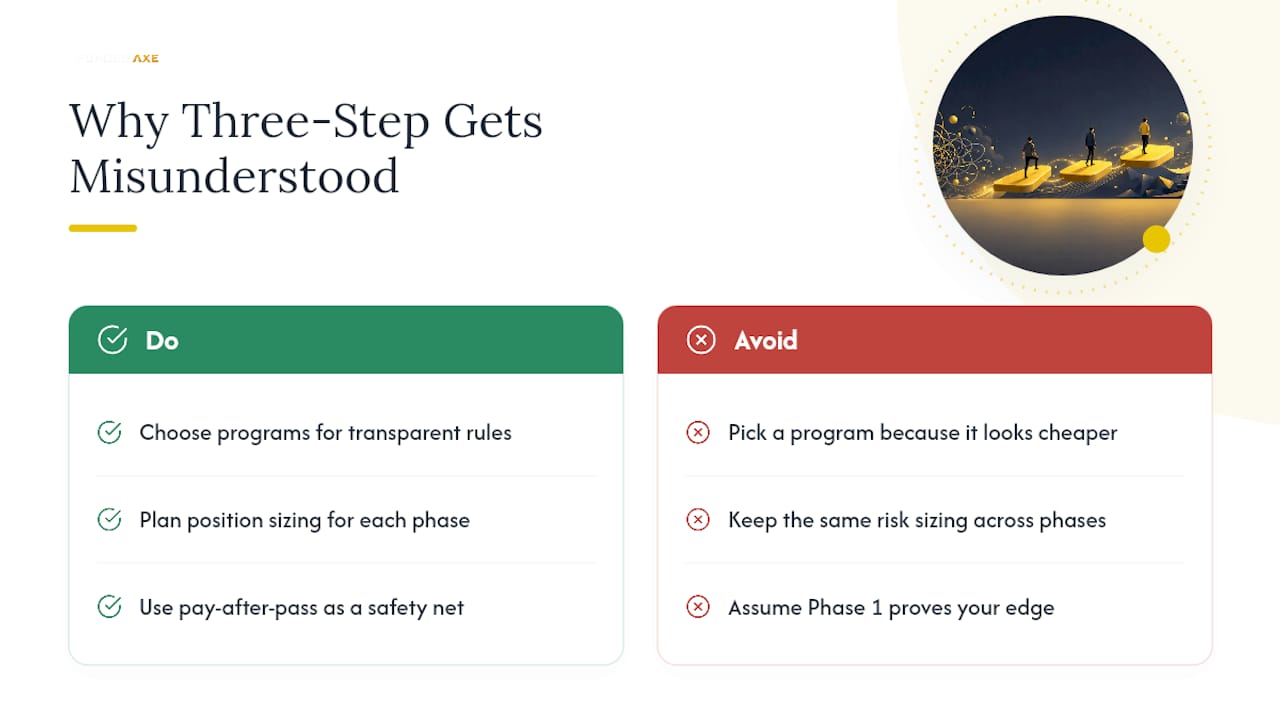
The conventional advice to “just trade your normal strategy across all three phases” undersells how much sizing discipline needs to tighten as you progress. Your Phase 1 risk tolerance is almost never appropriate for Phase 3.
What I’d prioritize first: don’t pick a three-step program because it looks cheaper upfront. Pick it because the rules are transparent enough that you can plan your sizing around them before you ever place a trade. A pay-after-pass structure removes some of that financial risk while you figure that out, which is exactly the kind of safety net a consistency-focused trader should want.
— Jean
Why FundedAxe Fits the 3 Step Trader Profile
If the checklist above is your filter, run FundedAxe’s three-step evaluation against it. Rules are static and balance-based, so your drawdown limit doesn’t creep as you bank profit. There’s no time limit on any phase, no consistency rules to trip you up after a strong run, and news trading, weekend holding, and EAs are all permitted from day one.

The Pay After Pass model lets you start a three-step evaluation for $9.99 and only pay the remaining challenge fee once you’ve actually passed, which matches the exact risk-reduction logic a patient, consistency-focused trader is looking for. Compare account sizes, fees, and add-ons for yourself on the package comparison page, or head straight to the challenges page to start your evaluation today.
Sources
- Three-Step Challenge Prop Firms | Prop Firm Match
- 3-Step Prop Firm Challenges (2026): Ranked & Compared - PropFirmMap