
Prop Traders: Calculate Your Real Stop for Daily vs Overall Drawdown

Daily drawdown is the single-session loss cap that resets every trading day. Overall (max) drawdown is the lifetime loss ceiling that follows your account from day one until you pass or fail. Both run at the same time, and the one that ends your challenge first is whichever floor sits closer to your current equity. The fix is simple: calculate both floors before you place a trade, then treat the tighter number as your real stop for the day.
TL;DR:
- Traders must confirm whether their firm uses balance-based or equity-based monitoring, as it significantly impacts how floating losses affect drawdown limits.
- The tighter of the daily or overall drawdown floors dictates the maximum risk for each trading day, and should be recalculated daily at the reset time.
- Static max drawdown remains fixed from account start, while trailing max drawdown increases as account equity rises, which can introduce psychological risks.
- Knowing whether a firm’s drawdown rules are static or trailing and whether they measure against balance or equity can change risk management strategies and position sizing.
- Verify drawdown rules through official documentation before committing to a funded challenge, watching for vagueness or hidden calculation methods.
Table of Contents
- What Is Daily Drawdown and How Do Firms Calculate It?
- What Is Overall Drawdown, and What’s the Difference Between Static and Trailing?
- How Do Daily and Overall Drawdown Interact, and Which One Binds First?
- Balance vs Equity Monitoring: The Calculation Choice That Changes Everything
- Step-by-Step: Your Daily Drawdown Checklist Before You Trade
- How Do You Verify a Firm’s Drawdown Rules Before You Pay for a Challenge?
- Which Drawdown Model Actually Fits Your Trading Style?
- Compare Drawdown Rules Before You Commit to a Challenge
- Sources
What Is Daily Drawdown and How Do Firms Calculate It?
Daily drawdown exists to stop one terrible session from wiping out an account in a single sitting. It typically resets at a fixed server time, usually midnight platform time, and locks in a fresh floor based on your balance or equity at that reset moment. Most firms set the daily drawdown between 3% and 5% of that starting number, and many count unrealized, floating losses toward the limit in real time rather than waiting for the trade to close.
That last detail is where traders get caught. Here’s the mechanic that trips people up:
- You start the day with $10,000 and a 5% daily floor, putting your hard stop at $9,500.
- A trade moves in your favor and your equity climbs to $10,400 intraday.
- If the firm uses equity-based monitoring, your floor doesn’t move, but your open position reverses hard.
- Equity drops back to $9,480. You’ve technically never lost more than $920 from your starting balance, yet the system flags a breach because it was tracking your floating peak, not just your closed balance.
That gap between balance-based and equity-based counting is the entire ballgame for day traders. Ask the firm which one governs before you risk a dollar.
What Is Overall Drawdown, and What’s the Difference Between Static and Trailing?
Overall drawdown, sometimes called max drawdown, is the total loss an account can absorb over its entire life before the challenge or funded account gets shut down. Unlike the daily limit, it never resets. It only tightens as your balance or equity approaches it, and it functions as the outer wall around every other rule.
How that wall behaves depends entirely on whether it’s static or trailing:
- Static max drawdown fixes the floor to your starting balance and leaves it there permanently. A $50,000 account with a 10% static floor has a $45,000 stop on day one and a $45,000 stop a year later, regardless of how much profit sits above it.
- Trailing max drawdown raises the floor as your peak equity rises, and that floor never comes back down. The same $50,000 account with a 10% trailing floor starts at $45,000, but once equity peaks at $55,000, the floor climbs to $49,500.
- Static floors get more forgiving as you bank profit. Trailing floors get stricter the more successful you become, which is a psychological trap for traders who assume profit equals safety.
Overall drawdown ranges commonly sit within typical loss limit ranges across the industry, though the exact percentage matters far less than which variant you’re playing under.
How Do Daily and Overall Drawdown Interact, and Which One Binds First?
Both limits run in parallel from the moment you open a challenge, and most prop firms enforce both simultaneously — breach either one and the account is done. The rule that decides your actual risk on any given morning isn’t the headline percentage. It’s whichever floor sits closer to your current equity right now.
Here’s the method:
- Calculate your static or trailing max floor:
initial_balance × (1 - max_dd%), orpeak_equity - trailing_amountif trailing applies. - Calculate today’s daily floor from start-of-day equity:
start_equity × (1 - daily_dd%). - Subtract your current equity from each floor. The smaller gap is your real headroom for the day.
A single catastrophic loss on a $25,000 account with a typical daily limit will usually hit the daily wall long before it touches the max drawdown floor, which is typically set higher. A slow bleed across three weeks of small losing days does the opposite: daily floors reset clean every morning, but the max floor keeps creeping closer with every red session.
Pro Tip: Set your hard stop-loss order at whichever floor is numerically closer to current equity, recalculated fresh at every daily reset, not just once at account opening.
Balance vs Equity Monitoring: The Calculation Choice That Changes Everything
The single biggest variable in how strict a drawdown rule feels isn’t the percentage. It’s whether the firm measures against your closed balance or your floating equity.
- Balance-based monitoring only counts closed trades. Open positions can swing wildly without touching your floor until you hit close. This favors swing traders holding positions overnight.
- Equity-based monitoring counts every tick of unrealized P&L against the floor in real time, which is why intraday peaks and consecutive losing swings matter so much to your actual risk exposure. A path that dips hard mid-trade and recovers can still trigger a breach the moment it touches the line.
- End-of-day enforcement checks only at the reset, giving intraday volatility room to breathe.
- Continuous intraday enforcement checks constantly, which rewards tighter stops, smaller size, and taking partial profit before volatility spikes.
Know which model governs your account before you size a single position. It changes your whole approach.
Step-by-Step: Your Daily Drawdown Checklist Before You Trade
Run this sequence every morning before your first trade, not after your first loss.
- Pull your start-of-day equity. This is your baseline for the daily floor calculation.
- Compute the daily floor:
start_equity × (1 - daily_dd%). Write the actual dollar number down, not the percentage. - Compute the max floor, static or trailing depending on your firm’s rules, using the formulas from the section above.
- Identify the binding floor, whichever number sits closer to your current equity.
- Size your position so a single worst-case loss never exceeds roughly 20 to 25% of the distance to that binding floor. If your floor is $500 away, your max acceptable single-trade loss is around $100 to $125.
- Check the economic calendar. High-volatility news sessions widen your worst-case slippage, so tighten size or sit out entirely if a red-folder event lands mid-session.
- Set a hard daily stop that closes all positions once you’re down a fixed percentage of the daily floor, before you actually touch it.
- Walk away once that internal stop hits. Revenge trading after one bad loss is how a survivable day turns into an account-ending one.
Pro Tip: Recalculate your floors every single morning, even on winning streaks. A trailing max drawdown moves the wall closer with every new equity peak, and traders who skip the daily recalculation get blindsided by a floor that quietly crept up on them.
Most challenge failures trace back to breaching a loss limit rather than a bad trading idea, which means knowing the specific calculation rules matters as much as having an edge.
How Do You Verify a Firm’s Drawdown Rules Before You Pay for a Challenge?
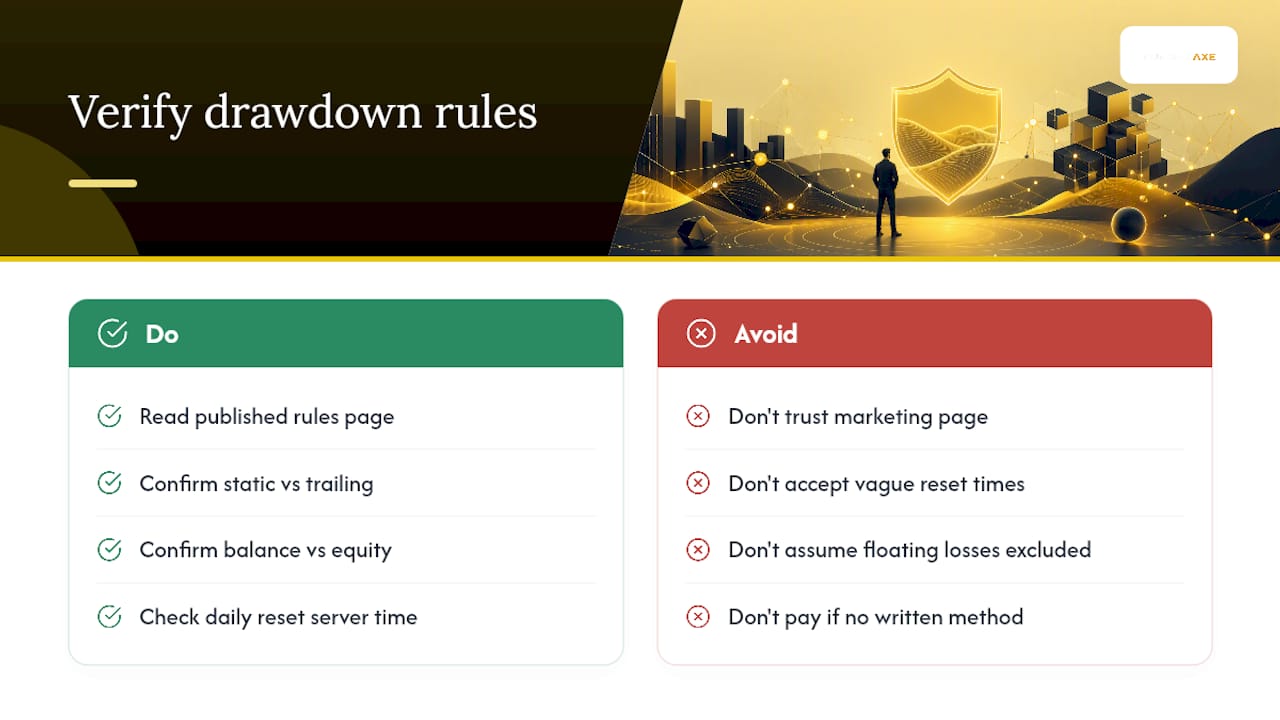
Read the published rules page, not the marketing page. A firm’s trading rules document should state plainly whether drawdown is static or trailing, whether it’s balance or equity based, and the exact server time daily limits reset. FundedAxe publishes this on its rules page alongside its Pay After Pass structure, where the $9.99 evaluation fee lets you confirm those exact mechanics on a live account before paying the remaining challenge cost.
Watch for red flags on any firm’s page: vague language like “drawdown resets daily” with no stated time zone, no clarity on whether floating losses count, or a calculation method that only appears buried in a support ticket instead of the official rules. If a firm won’t state its method in writing, assume the strictest interpretation until proven otherwise.
Which Drawdown Model Actually Fits Your Trading Style?
Static drawdown paired with balance-based monitoring is the more forgiving combination, and it suits swing traders and anyone still building consistency. It gives open positions room to breathe overnight and doesn’t punish you for a temporary equity dip that recovers before the candle closes.
Trailing drawdown with equity-based monitoring belongs to disciplined intraday traders who can execute tight stops without hesitation, since early profits under a trailing floor actually tighten your safety margin rather than loosen it. Match the rule set to your actual edge, not to whichever challenge happens to be cheapest that week. A great strategy under the wrong drawdown model still fails.
— Jean
Compare Drawdown Rules Before You Commit to a Challenge
Reading about static and trailing floors only helps once you can see the actual numbers side by side. FundedAxe’s package comparison page lists every account size from $5,000 up to $400,000 with its drawdown type, daily monitoring approach, and evaluation structure laid out together, so you’re not guessing which model you’re signing up for.

If you’d rather confirm the math before spending real money, some firms offer pay-after-pass evaluations that let you test how the daily and overall floors behave on your own trading style at minimal upfront cost. Once you pass, reward requests open on day 10 and repeat every 14 days, with details on splits and cadence available on the payouts page. Pick the account size and evaluation structure that matches the drawdown model you just worked out, and start the challenge that fits how you actually trade.
Sources
- Prop firm drawdown rules explained: daily, overall, trailing, static
- Daily drawdown vs max drawdown: key differences explained (TradeClaris)
- Conditional expected drawdown and drawdown risk contributions (academic paper)