
Do Prop Firms Pay Traders? What the Payouts Really Show

Yes, prop firms pay traders, but whether you get paid depends heavily on the firm’s business model, its payout conditions, and whether you can actually verify its track record before you commit. That distinction is where most of the confusion online comes from. Some firms structure themselves around evaluation fees and can profit even if nobody ever gets paid. Others build their entire reputation on fast, transparent payouts because repeat business depends on it.
Three caveats matter before you trust any prop firm with your time or money:
- The model matters more than the marketing. Retail-funded firms running profit-split and challenge models operate very differently from institutional trading desks, and payout reliability varies widely between them.
- Fee-driven revenue can create a conflict of interest. A firm earning most of its money from challenge fees gets paid whether or not a trader ever reaches payout eligibility.
- Screenshots are not proof. Payout claims posted on social media or a firm’s own site are easy to fabricate; real verification takes a bit more digging.
The rest of this article walks through how prop firms actually make money, what compensation looks like in practice, and gives you a verification checklist you can run in about 20 minutes before you buy any evaluation.
Key Takeaways
Prop firms do pay traders, but payout reliability depends on the firm’s revenue model, its published payout terms, and whether a trader verifies those terms before paying for an evaluation.
| Point | Details |
|---|---|
| Business model drives incentive | Fee-heavy firms profit regardless of trader success, so verify payout terms before paying. |
| Compensation varies by firm type | Institutional roles offer salaried stability; retail-funded firms offer profit splits with more upside and more risk. |
| Payout mechanics follow a set path | Expect KYC checks, minimum thresholds, and a stated payout cadence before money moves. |
| Test small before trusting big | A quick, successful first payout tells you more about reliability than any marketing claim. |
| Fundedaxe ties fees to success | Pay After Pass and a published payout cadence starting day 10 reduce upfront risk for new traders. |
Table of Contents
- How Do Prop Firms Pay: Understanding the Business Models Behind It
- What Compensation Models Do Prop Firms Actually Use?
- How Do Prop Firm Payouts Actually Work?
- Do Simulated Funded Accounts Really Pay Out Real Money?
- Do Prop Firms Pay Traders Enough to Make It Worthwhile?
- What Red Flags Suggest a Prop Firm Won’t Pay?
- How Can You Verify a Prop Firm Will Actually Pay You?
- How Fundedaxe Approaches Payout Transparency
- What Laws and Regulations Govern Prop Firm Payouts?
- How Are Prop Firm Earnings Taxed?
- A Verification-First Take on Prop Firm Payouts
- Want a Transparent Way to Try Funded Trading?
- Frequently Asked Questions
- Sources
How Do Prop Firms Pay: Understanding the Business Models Behind It
The honest answer to “do prop firms pay” starts with understanding how the firm in front of you makes money. Prop firms generally pull revenue from three places, and each one shapes how motivated that firm is to pay you.
The first is evaluation or challenge fees. A trader pays to attempt a funded account, and if they fail (which most do), the firm keeps the fee. The second is spreads and commissions collected when the firm’s broker infrastructure executes a trader’s orders, win or lose. The third, used mostly by institutional desks, is proprietary trading profit retention, where the firm trades its own capital and traders share in real market gains.
These models create very different incentive structures, as detailed in The Prop Firm Wave: Prediction Markets Just Got Their Trading Floor - Assymetrix | Prediction Markets Intelligence, which analyzes the institutionalization of prop firms and industry trends. A firm living almost entirely on challenge fees earns money the moment you buy an evaluation, regardless of what happens next. That is not automatically a red flag. Plenty of legitimate firms use challenge fees to fund the reward pool that pays successful traders. But it does mean the firm’s short-term revenue does not depend on you succeeding, which is exactly why verification matters more here than it would with, say, a salaried trading desk.
Firms built around institutional-style proprietary trading, by contrast, tend to align incentives more directly with performance. Jane Street’s own materials describe a quantitative, team-based structure where compensation flows from actual trading results rather than fee volume. Some retail firms also incorporate high-frequency trading style execution in their internal books, which changes how they generate returns and, by extension, how sustainable their payout pool is.
Retail-funded firms that lean heavily on fee income are worth extra scrutiny. As one recruiting analysis of the proprietary trading industry points out, evaluation-fee models can create a structural misalignment: the firm gets paid up front no matter how the trader performs. That does not mean a fee-funded firm won’t pay you. It means you should check the payout mechanics before you assume it will.
What Compensation Models Do Prop Firms Actually Use?
Not every prop firm pays the same way, and the differences change what “getting paid” actually looks like in your bank account.
Institutional prop firms typically pay salaries plus discretionary bonuses tied to desk or firm performance, closer to a traditional employment structure. A recruiting guide covering the proprietary trading career track cites total compensation in a typical six-figure range as a reasonable expectation for legitimate institutional roles, though this varies by firm, seniority, and market conditions. These roles usually require passing rigorous quantitative interviews, the kind of preparation candidates practice on platforms like LeetCode or InterviewCake before ever sitting for an assessment.
Retail-funded prop firms work almost entirely on profit splits.
Monthly stipends or fixed pay are rare in the retail-funded space and mostly appear in institutional or hybrid arrangements.
Commission or fee-offset models let some fee paid during evaluation apply toward future costs or get refunded on a later milestone.
| Model | Typical structure | What it means for take-home pay |
|---|---|---|
| Institutional salary | Base pay plus bonus, often $100K to $200K total comp | Stable income, less upside tied to any single trade |
| Retail profit split | 90% to 100% of simulated account profits | Income scales with performance but resets each cycle |
| Monthly stipend | Fixed periodic payment, uncommon in retail | Predictable but rarely offered outside institutional desks |
| Fee-offset/refund | Upfront fee credited or refunded on a milestone | Lowers effective cost, doesn’t replace ongoing income |
The trade-off is straightforward: salaried roles offer stability but cap the upside, while profit-split models offer bigger potential earnings but expose you to drawdown rules, consistency requirements, and evaluation costs that eat into realized income. A trader who nets $3,000 in simulated profit on an 90% split still needs to clear KYC and any consistency checks before that number becomes real money in a bank account.
How Do Prop Firm Payouts Actually Work?
Getting paid follows a fairly predictable sequence, even though the details vary by firm.
Step 1: Profits get realized. You hit your profit target or simply trade profitably on a funded account, and the gain shows up in your account equity.
Step 2: Eligibility checks kick in. Most firms require Know Your Customer (KYC) verification, a minimum payout threshold, and sometimes a minimum number of trading days before releasing funds. Some also apply consistency rules that check whether your profit came from one lucky trade or a repeatable pattern.
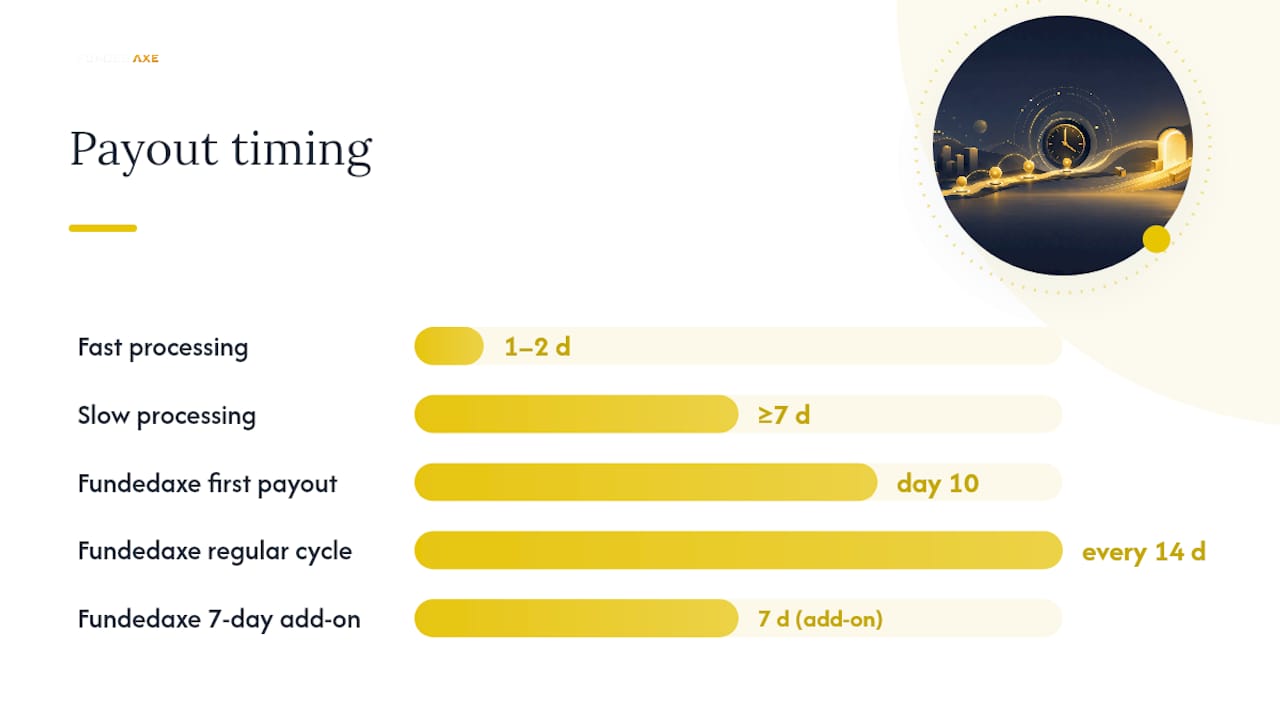
Step 3: The payout gets processed. This is where firms differ most. Some process withdrawal requests within a day or two; others take a week or longer, especially during a first payout when KYC documentation is still being reviewed.
Step 4: Money moves through a payment method. Bank transfer, cryptocurrency, and PayPal are the three most common rails. Crypto transfers tend to settle faster but come with their own volatility and network-fee considerations.
A few things to watch on timing and restrictions:
- Minimum payout amounts vary, and some firms won’t process a request below a set threshold.
- First-time KYC verification often adds delay compared to subsequent payouts once your identity is confirmed.
- Some firms require proof-of-trade documentation before releasing larger sums.
- Payout frequency (weekly, biweekly, or on request after a set number of days) is usually spelled out in the trader agreement, and firms that publish this clearly are easier to trust than ones that keep it vague. Fundedaxe, for example, lets traders request rewards starting on day 10 and then every 14 days, with a faster 7-day cycle available as an add-on. Details worth reading in full are in how prop firm payouts, splits, and cycles work.
Pro Tip: Request your first payout the moment you’re eligible, even if it’s small. A quick, uneventful withdrawal tells you more about a firm’s reliability than any marketing page ever will. If it drags on with vague excuses, treat that as your answer.
Do Simulated Funded Accounts Really Pay Out Real Money?
Yes, and this confuses a lot of traders who assume “simulated” means “fake.” A simulated funded account means the trades themselves don’t touch live market liquidity. Your buy and sell orders are tracked internally by the firm rather than routed to a real exchange. But the money you’re paid when you hit a reward threshold is real, because the firm has contractually agreed to pay it based on your performance.
The legal mechanism here is the trader agreement. It specifies that once you meet the conditions (profit target, drawdown compliance, KYC, consistency rules), the firm owes you a real cash payout calculated from your simulated results. This is functionally similar to how a fantasy sports platform pays real prize money based on performance in a game that never touches an actual football field.
The catch is that this arrangement only works if the firm actually honors the agreement. That’s why a few signals matter more than others when you’re deciding whether to trust a simulated-account provider:
- A published, specific payout policy, not vague language about “processing times may vary.”
- Publicly available payout confirmations that go beyond a single cherry-picked screenshot.
- Independent, unaffiliated reviews confirming the pattern holds across many traders, not just a handful.
- A clear description of drawdown type (static versus trailing) since that single rule determines whether many near-miss traders get disqualified before they ever reach payout. Comparing how a firm handles prop firm trading rules and drawdown limits against your own trading style is worth doing before you buy an evaluation.
Do Prop Firms Pay Traders Enough to Make It Worthwhile?
The honest answer is: it depends heavily on which stories you’re reading. Public “I got paid $50,000” posts are real in some cases, but they suffer badly from survivorship bias. You see the trader who cleared a large evaluation and hit a big payout; you don’t see the much larger group who failed the challenge, blew the drawdown limit, or never requested a payout because their profit never cleared the minimum.
Institutional roles offer more grounded numbers. The proprietary trading recruiting guide cited earlier puts legitimate total compensation in the $100,000 to $200,000 range for many institutional prop roles, a figure built on salary structures rather than volatile trading outcomes. That is a useful anchor because it comes from an employment relationship, not a marketing claim.
For retail-funded accounts, a more realistic framing is this: if you can consistently generate 5% to 8% monthly returns on a funded account (a genuinely strong result that few traders sustain), a $50,000 account at a 90% split nets meaningfully less once you subtract the challenge fee, factor in any months where drawdown resets progress, and account for the fact that consistent monthly performance at that level is rare even among skilled traders.
What actually correlates with getting paid repeatedly is not one big trade. It’s:
- Small, repeatable edge applied consistently across many trades rather than one outsized win.
- Strict adherence to whatever drawdown and consistency rules the firm enforces.
- Choosing account sizes and profit-split structures that match your actual risk tolerance, not the biggest number on the pricing page.
What Red Flags Suggest a Prop Firm Won’t Pay?
A handful of warning signs show up again and again in trader complaints and forum threads, and most of them are visible before you ever pay a challenge fee.
Operational red flags:
- No published payout schedule anywhere on the site, or one that’s vague (“payouts processed periodically”).
- Support that gives evasive or inconsistent answers when directly asked about payout timing.
- Payout “proof” limited to screenshots the firm itself posts, with no independent confirmation.
- No written KYC or payout policy in the trader agreement.
Contractual red flags:
- Payout triggers described in ambiguous language that leaves room for the firm to deny a request after the fact.
- Consistency or minimum-trading-day rules so strict they seem designed to disqualify most winners.
- Surprise fees or chargebacks applied to a payout after it’s requested.
Reputational red flags:
- A pattern of unresolved complaints on independent sites or forums, especially ones describing the same specific issue (delayed KYC, sudden rule changes, payout denials) repeatedly. A single bad review means little; a cluster describing the identical problem is worth taking seriously. Reading through a breakdown of which prop firm rules actually decide payout eligibility before signing up can help you spot these clauses in advance.
How Can You Verify a Prop Firm Will Actually Pay You?
Run this checklist before you buy an evaluation, not after you’ve already paid for one.
- Read the trader agreement’s payout section line by line. Look specifically for the exact conditions that trigger a payout and any language that lets the firm delay or deny one.
- Confirm the published payout cadence and methods. Weekly, biweekly, or on-request; bank transfer, crypto, or PayPal. Vague answers here are a warning sign, not a formality.
- Check independent reviews on sites the firm doesn’t control. Look for patterns, not isolated complaints, and weigh recent reviews more heavily than old ones.
- Confirm KYC timelines up front. Ask support directly how long identity verification typically takes before a first payout clears.
- Request a small test payout as soon as you’re eligible. This is the single most reliable, real-world test available to you.
If any step fails, that’s information, not an inconvenience to push past. A firm that stonewalls a simple payout-policy question before you’ve even paid is unlikely to improve once it has your money.
Pro Tip: Treat the first payout request like a stress test, not a formality. A clean, on-time first withdrawal, even a modest one, tells you far more about a firm’s reliability than any testimonial page.
How Fundedaxe Approaches Payout Transparency
Fundedaxe was built around a simple idea: reduce the upfront risk a trader takes before proving anything is real. The clearest expression of that is Pay After Pass, where a trader starts an evaluation for $9.99 and only pays the remaining challenge fee once they’ve actually passed, instead of handing over the full cost before knowing whether they can clear the rules.

That structure flips the usual incentive problem. A firm earning most of its revenue from failed challenges has less reason to make passing easy or payouts fast. Fundedaxe’s model ties more of its revenue to traders who actually succeed, which is a meaningfully different incentive than a pure fee-collection business.
Beyond that, a few features specifically reduce payout friction:
- A free simulated $1,000 trial account, with no card and no deposit required, lets a trader test the platform’s rules and interface before spending anything.
- Reward requests open on day 10 and repeat every 14 days, or every 7 days with the faster payout add-on, giving traders a predictable cadence rather than an open-ended wait.
- Static, balance-based drawdown with no time limit removes some of the more punishing technicalities that quietly disqualify traders elsewhere.
- A reward split starting at 90%, extendable to 100% with an add-on, sets clear expectations before a trader ever puts money down.
For readers who want the specific numbers rather than a summary, the FundedAxe payouts and rewards page lays out payout policy in detail, and the package comparison page breaks down how account sizes, fees, and rules stack up against each other.
What Laws and Regulations Govern Prop Firm Payouts?
Prop firms occupy a gray zone in most jurisdictions. Firms offering simulated funded accounts generally aren’t regulated the same way as brokers handling client deposits, because traders aren’t depositing funds to be traded on their behalf in a live market. Instead, the relationship is contractual: the trader agreement is a private commercial contract specifying when and how the firm pays based on simulated performance.
That distinction matters because it shifts the burden of protection from a regulator onto the contract itself. There’s no equivalent of deposit insurance or a brokerage regulator stepping in if a firm refuses to pay. If a dispute arises, a trader’s recourse usually runs through the terms laid out in that agreement, and in some cases through consumer protection law in the trader’s own jurisdiction, rather than through financial-markets regulation.
This is a meaningful reason the legitimacy of prop firms deserves real scrutiny rather than a quick glance at a firm’s homepage. Because oversight is thinner than in traditional brokerage, the contract language itself becomes the primary protection a trader has. Firms that publish clear, specific payout terms and stick to them consistently are, in effect, substituting transparency for the regulatory guardrails that don’t otherwise exist in this space.
Institutional prop desks operate under a different regulatory posture entirely, since they trade firm capital directly in regulated markets and fall under standard securities and derivatives oversight in their operating jurisdiction. That’s one more structural reason institutional and retail-funded models shouldn’t be judged by the same yardstick.
How Are Prop Firm Earnings Taxed?
Earnings from a prop firm payout are generally treated as taxable income, though the exact category depends on the trader’s country of residence and how that jurisdiction classifies the payment. Some tax authorities treat prop firm rewards as self-employment or business income since the trader isn’t an employee of the firm. Others may treat it closer to a contractor payment or miscellaneous income, depending on local rules.
Because the underlying trading happens on a simulated account, some traders assume the payout might not count as taxable income the way live-market trading gains would. That assumption is risky. Tax authorities generally look at the substance of the transaction (real money received for a service or performance-based reward) rather than the mechanics of the account that produced it. A payout that lands in a bank account is income regardless of whether the trades behind it touched a live exchange.
Record keeping matters more here than most new traders expect. Keeping documentation of each payout, the firm’s trader agreement, and any fees paid (which may be deductible as a business expense in some jurisdictions) makes tax season considerably less painful. Because rules vary significantly by country and even by how a specific tax authority classifies prop trading income, this is one area where a conversation with a local tax professional is worth the cost, rather than relying on a forum thread written by someone in a different country with entirely different rules.
A Verification-First Take on Prop Firm Payouts
Most of the skepticism around prop firms comes from a reasonable place: the industry has a real history of fee-driven firms that made passing an evaluation deliberately hard while collecting revenue regardless. That history is worth remembering, but it shouldn’t collapse into blanket distrust of the entire model. The firms solving this problem aren’t the ones making the loudest promises. They’re the ones publishing specific payout terms and letting traders test the process with small amounts before committing real evaluation fees.
If there’s one habit worth adopting from this whole conversation, it’s treating payout proof the way a skeptical auditor would, not the way a hopeful trader would. Screenshots prove almost nothing on their own. A firm’s own testimonial page proves even less. What actually tells you something is a firm’s response to a direct, specific question about timing, methods, and eligibility, and how consistently it processes small payout requests without friction. Run that test before you run a bigger one with real money on the line.
Want a Transparent Way to Try Funded Trading?
If everything above has you thinking carefully before paying for a challenge, that instinct is worth keeping. Fundedaxe was built around lowering that exact risk. With Pay After Pass, you start an evaluation for $9.99 and only pay the rest of the fee once you’ve actually passed, so you’re not betting a full challenge fee on rules you haven’t tested yet.

Beyond that entry point, Fundedaxe offers a free simulated $1,000 trial account with no card and no deposit, account sizes up to $400,000, static drawdown with no time limit, and a reward split starting at 90% (up to 100% with an add-on). Reward requests open on day 10 and repeat every 14 days, or every 7 days with the faster payout option. If you’re ready to compare account sizes and rules side by side, the package comparison page breaks down every challenge option so you can pick one that matches how you actually trade.
Frequently Asked Questions
Do prop firms pay traders real money, or is it all simulated? The trading itself often happens on a simulated account, but payouts owed under the trader agreement are paid in real money once you meet the eligibility conditions.
Are forex prop firms legit, or is the whole model a scam? Legitimacy varies firm by firm rather than being true or false for the entire industry. Firms with published payout policies, verifiable track records, and clear trader agreements tend to be legitimate; firms that dodge specific payout questions deserve extra scrutiny.
How do prop firms pay traders once they’re eligible? Most pay through bank transfer, cryptocurrency, or PayPal, following KYC verification and a stated payout cadence outlined in the trader agreement.
Do proprietary firms pay salaries, or is it always profit split? Institutional prop desks typically pay salaries plus bonuses. Retail-funded firms almost always use profit splits instead of fixed pay.
Are prop firms profitable for the average trader? Most traders who buy an evaluation never reach payout eligibility, largely due to drawdown limits and consistency rules. Consistent, disciplined traders who respect those rules have a realistic shot at steady payouts, though outsized public success stories are the exception rather than the norm.
What’s the fastest way to check if a prop firm actually pays? Request a small payout the moment you’re eligible and watch how quickly and transparently it gets processed. That single test reveals more than reviews or testimonials ever will.
Sources
- Proprietary Trading: Full Career and Recruiting Guide
- Jane Street trading interview PDF
- High-frequency trading — Wikipedia