
Start at $9.99: Evaluation Pricing Models for Traders

Beginners and unproven traders belong in a low-cost evaluation or challenge model. Consistent traders with a track record save money with instant funding or a Pay After Pass structure, since they skip paying for phases they’ll pass anyway. Time-constrained traders often accept instant funding’s higher fee just to start trading now. The real trade-off is always upfront cost versus ongoing account constraints, and FundedAxe’s Pay After Pass model, starting at $9.99, is worth checking before you commit real money to either extreme.
TL;DR:
- Pay-after-pass models often cost less overall because traders pay only after passing, reducing the risk of paying for unsuccessful attempts.
- The actual cost per $1,000 of capital varies greatly depending on fees, profit splits, and refund policies, affecting the break-even point.
- Instant funding typically has higher upfront fees and stricter drawdowns but offers speed and higher profit splits for experienced traders.
- Planning for 1.5 to 2 attempts is realistic, as industry pass rates are generally low, making multiple attempts likely necessary.
- Refund policies and payout cycles can significantly impact total costs, so traders must carefully review terms before choosing a model.
Table of Contents
- How Do Evaluation Pricing Models Actually Differ?
- What Does an Evaluation Actually Cost You?
- How Do You Pick the Right Model for Your Trading Style?
- What Do Three Real Trader Budgets Look Like?
- Why Transparent Fee Math Matters More Than the Headline Price
- Compare Challenge Packages Before You Commit
- Further Reading and Primary Sources
- Sources
- FAQ
How Do Evaluation Pricing Models Actually Differ?
Every prop firm’s pricing model answers the same question differently: when does the trader pay, and what do they get for it? Three structures dominate the market, and each shifts risk in a different direction.
The evaluation or challenge model charges a modest entry fee and asks the trader to prove themselves first. Phase 1 profit targets typically run 8 to 10 percent, with Phase 2 often set near 5 percent under a static drawdown limit. Pass both phases, and the fee has already covered the firm’s cost of letting you try.
Instant funding skips the proving ground entirely. You buy access to a funded account outright, but that convenience carries a real price: fees run several times higher than an equivalent challenge, and firms typically compensate for the added risk with tighter drawdown limits and a lower starting profit split.
Pay-after-pass and refund variants split the difference. You pay a small amount to start, then cover the rest of the fee only once you clear the evaluation, which moves the financial risk from “did I waste my ticket” to “will the firm pay out on time.” Some firms sweeten upfront challenges by refunding the fee on your first payout, though that refund usually comes with strings attached.
Here’s how the three stack up on the axes that actually matter to your wallet:
- Upfront cost: Evaluation, lowest. Pay-after-pass, near-zero to start. Instant funding, highest.
- Refundability: Varies by firm; instant funding rarely refunds anything.
- Profit split: Evaluation-based accounts commonly open at 80 to 90 percent; instant funding often starts at 60 to 80 percent.
- Drawdown type: Static (balance-based) is more forgiving than trailing.
- Payout timing: Fixed cycles versus firm-specific request windows.
- Allowed strategies: News trading, weekend holding, and EAs vary widely by provider.
A quick reality check: profit splits alone can swing your effective earnings by 20 to 30 percentage points between models, before you even factor in the entry fee.
What Does an Evaluation Actually Cost You?
The sticker price on a challenge is never the whole story. Five line items determine what you actually pay:
- Entry fee: The upfront cost to start the evaluation, scaled by account size.
- Reset fee: Charged if you breach drawdown and want another attempt without buying a new challenge.
- Activation fee: A smaller charge some firms apply before you can start trading a funded account.
- Add-ons: Optional upgrades like a 100% reward split, faster payout cycles, or swap-free trading.
- Hidden costs: Wider spreads or slower execution on the funded account, which quietly eat into your reward.
Calculating your real cost starts with a simple ratio: cost per $1,000 of capital. Divide the fee by the account size in thousands, then check that number against your expected profit split, since that combination determines your actual break-even point.
That last number is the one traders miss. You don’t need to hit your 8% profit target just to recoup the fee. You need to clear well under 1% in actual reward-eligible profit, assuming you pass without a reset.
Refunds change this math further. A firm that refunds your fee on the first successful payout effectively drops your net cost to zero, but only if you meet the minimum trading days and consistency rules the refund is tied to. Read the rulebook’s payout and refund sections before assuming that discount applies to you, and check what challenge fees really include before comparing two firms on price alone.
How Do You Pick the Right Model for Your Trading Style?
Match your profile to a model before you match a firm to your budget.
- New or unproven traders: Start with a low-cost evaluation. You’re paying to learn the firm’s rules, not to skip a step you’re not ready for.
- Consistent traders with a verified track record: Instant funding or Pay After Pass saves money, since you’re not gambling on phases you’d likely pass anyway.
- Time-constrained or high-frequency traders: Instant funding’s higher fee buys speed, even with a tighter drawdown limit.
Budget for more than one attempt. Industry guidance points to planning for 1.5 to 2 attempts rather than assuming a clean first pass, since published pass rates run low across the industry.
Run this checklist before buying anything:
- Calculate your cost per $1,000 of capital.
- Estimate your break-even profit after the split, not before.
- Confirm the drawdown type (static or trailing) and whether your strategy fits inside it.
- Verify refund triggers, payout cadence, and rules on EAs, news trading, and weekend holding.
Pro Tip: Screenshot the rulebook’s drawdown and payout sections before you buy. Firms update terms, and the page you read during research may not match the version active when you’re funded.
What Do Three Real Trader Budgets Look Like?
- Scenario A, the beginner. A $10,000 Pay After Pass evaluation starting at $9.99, with a realistic second attempt after a reset, lands total expected cost well under $150 and a funding timeline of a few weeks once both phases clear.
- Scenario B, the consistent trader. Someone with six months of demo consistency skips the challenge entirely and buys instant funding on a $50,000 account. The upfront fee is higher, but with zero evaluation risk, the math often comes out cheaper than two failed challenge attempts.
- Scenario C, the time-constrained pro. A trader who can’t tolerate a multi-week evaluation window pays the instant funding premium and accepts a tighter drawdown and a lower starting split, trading long-term earnings for speed today.
Why Transparent Fee Math Matters More Than the Headline Price
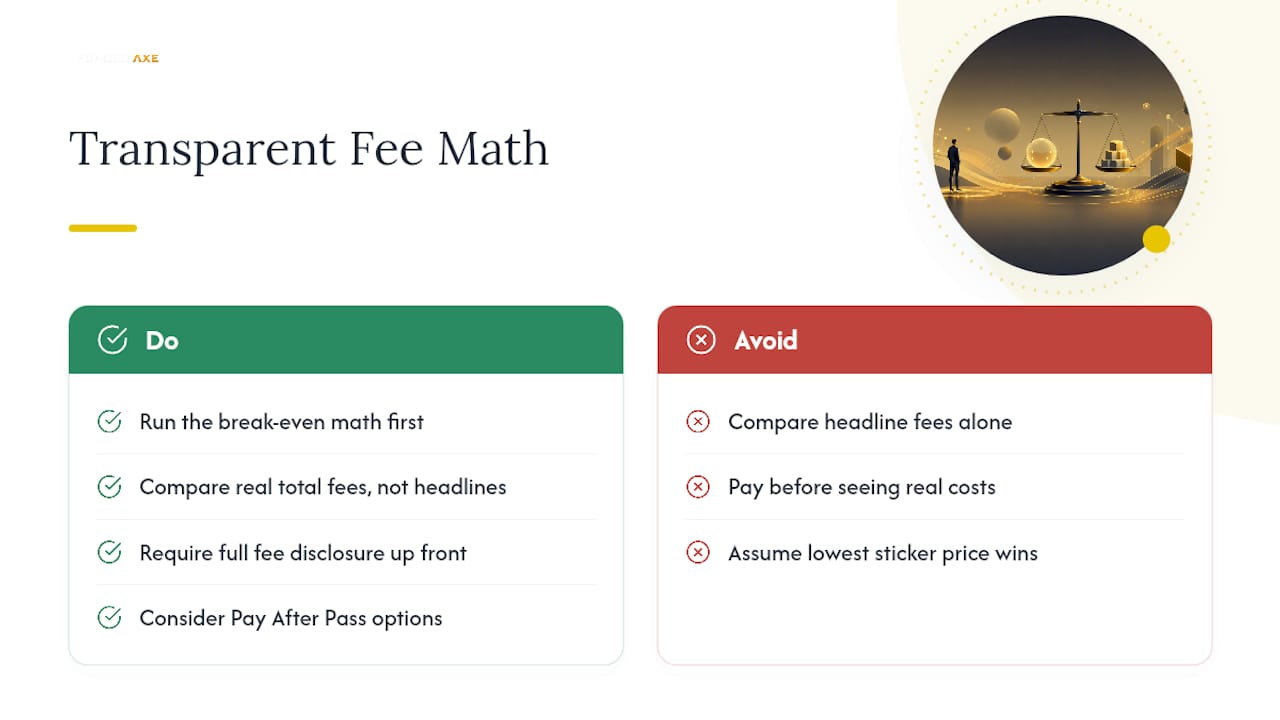
The biggest mistake traders make isn’t picking the wrong model. It’s comparing headline fees without running the break-even math first. Fundedaxe built its fee structure, including Pay After Pass, around the belief that traders should see the real number before they pay a cent of it.
— Jean
Compare Challenge Packages Before You Commit
Pay After Pass exists because most traders shouldn’t have to risk a full fee on an evaluation they haven’t started yet. You pay $9.99 to begin, and the remaining challenge fee comes due only once you actually pass. That single change removes the biggest financial risk in the evaluation model: paying upfront for an outcome you can’t guarantee.
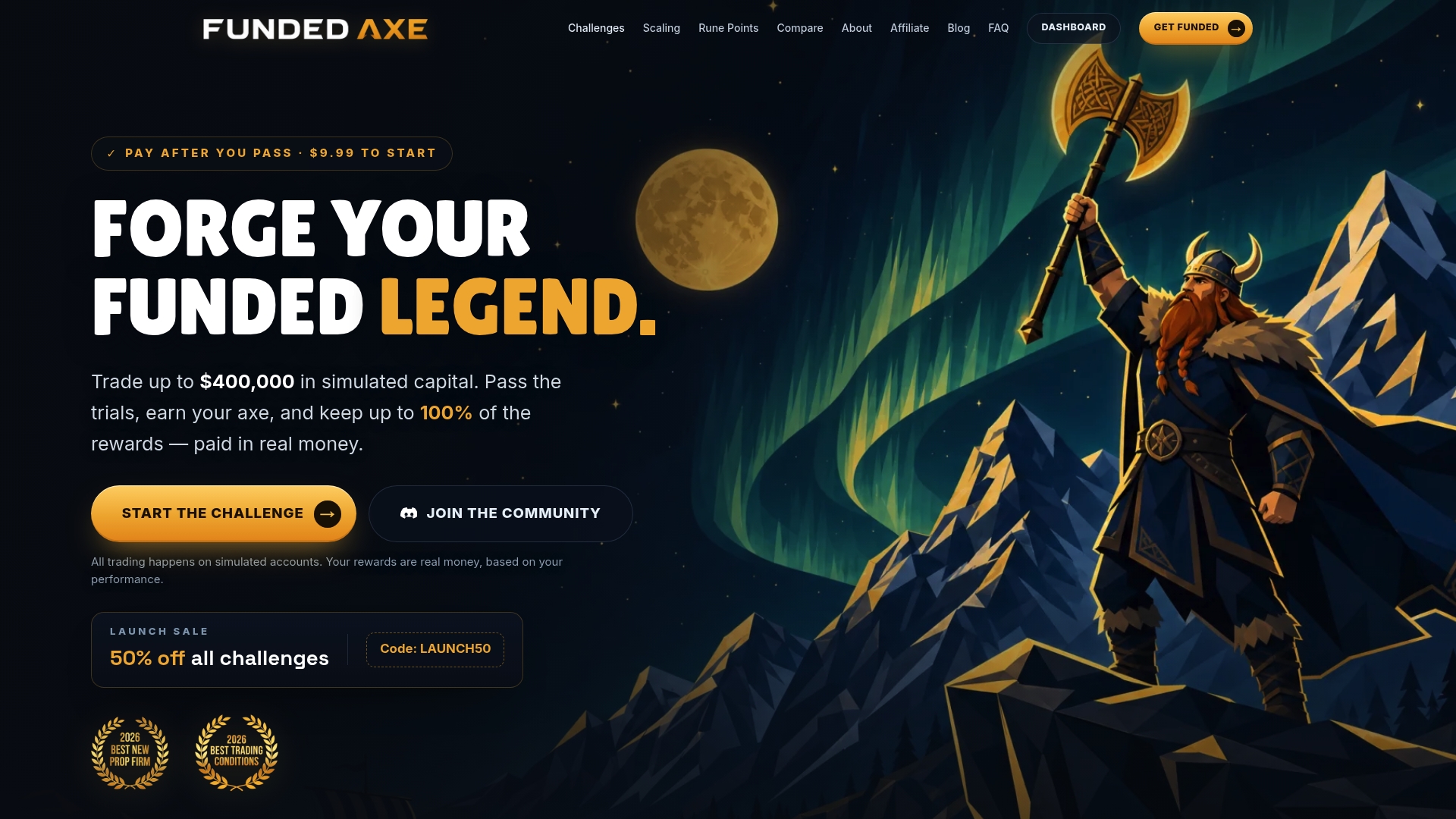
Fundedaxe backs that structure with rules built for traders who don’t want to be boxed in. No time limits on any phase, no consistency rules, news trading and weekend holding allowed, and EAs and algorithmic strategies permitted across 1-step, 2-step, and 3-step evaluations from $5,000 up to $400,000. Add-ons like a 100% reward split or 7-day payout cycles let you customize the account instead of accepting whatever the base package offers. If you want to see exactly how Pay After Pass stacks up against upfront challenges and instant funding on fees, splits, and drawdown rules, compare all FundedAxe challenge packages side by side and pick the structure that matches your budget and trading style.
Further Reading and Primary Sources
- Instant Funding vs Two-Step Challenge Prop Firms
- Instant Funding vs Challenge Model: Costs and Rules
- Prop Firms Explained: The Beginner’s Guide
- Static vs Trailing Drawdown Explained
Sources
- Instant Funding vs Two-Step Challenge Prop Firms: Which Is Worth It? | Monkeytrade
- Instant Funding vs Challenge Model Compares Costs and Rules
- Prop firms explained: the beginner’s guide (2026) | Roya Trading
FAQ
What Is the Difference Between Evaluation and Instant Funding Pricing?
Evaluation pricing charges a lower upfront fee and requires passing profit targets under drawdown rules first, while instant funding charges more upfront but skips the evaluation phase entirely.
How Do You Calculate Break-Even on a Prop Firm Challenge?
Divide the fee by your profit split to find the gross reward-eligible profit needed to recoup the cost, then express that as a percentage of your account size.
Does FundedAxe Refund the Challenge Fee?
FundedAxe’s upfront “Pro” challenges refund the fee on the trader’s second reward, while Pay After Pass avoids the refund question entirely by only charging the remaining fee after a pass.
How Many Attempts Should I Budget for a Challenge?
Plan for 1.5 to 2 attempts rather than assuming a clean first pass, since industry pass rates run low across most evaluation models.
Is Pay After Pass Cheaper Than a Traditional Upfront Challenge?
Pay After Pass reduces upfront cash-flow risk since you only pay $9.99 to start, with the remaining fee due only once you pass, making it lower-risk rather than always lower-cost overall.
Recommended
Educational content only, not financial advice. All FundedAxe accounts use simulated funds. No strategy guarantees a return.