
Prop Firm Traders: 4 Step Decision to Reset or Walk Away

Reset when the failure was an isolated execution error or a one-off news event and the reset fee is meaningfully cheaper than a fresh challenge. Skip it if you’ve already paid for two or three resets on the same account without fixing the actual problem. In that case, quantify the fee gap, read the firm’s reset clause line by line, and confirm whether your last breach came from a bad trade or a broken process before you pay again.
TL;DR:
- Resets cost between 30% and 60% of the evaluation fee, often ranging from $25 to over $100, depending on account size, and are limited to two or three per account with cooldown periods.
- Resetting only restores the account to its initial state without fixing underlying issues like poor sizing, discipline lapses, or technical errors, which often leads to repeated failures.
- It is essential to evaluate if a reset is justified by comparing reset fees with the cost of a new evaluation and ensuring the issue has been fully diagnosed and fixed beforehand.
- A comprehensive reset protocol involves a 24-hour cooling-off period, root cause analysis, demo testing of the fix, and a staged re-entry with smaller positions and tighter daily stops.
- FundedAxe’s approach with static drawdown accounts and pay-after-pass options provides a lower-cost path to confirming fixes and avoiding unnecessary resets, especially for strategy or discipline issues.
Table of Contents
- Evaluation reset rules prop firms use: what actually changes
- How reset policies vary: caps, fees, and the fine print
- Should you reset, buy new, or stop? A four-part diagnostic
- The risk math that decides whether your evaluation survives
- The reset protocol: cooling off, root cause, and re-entry
- Three scenarios that show the reset math in action
- Where FundedAxe fits into the reset decision
- Compare packages before you pay for another reset
- Where to verify the reset rules that actually apply to you
- Sources
Evaluation reset rules prop firms use: what actually changes
A reset restores your evaluation account to its starting balance, clears the rule violation that ended your attempt, and restarts the trading-day counter. That’s it. Your account looks like day one again, minus whatever you paid for the privilege.
What a reset does not do is fix the reason you failed. If you blew through a daily loss limit because your position sizing was too aggressive, resetting gives you a clean balance and the exact same sizing habit. Reset fees typically run 30 to 60% of the original evaluation cost, and firms designed the product that way on purpose: cheap enough to tempt a second attempt, not so cheap that traders treat it as a free do-over.
Here’s where a lot of traders get confused: resets and repurchases aren’t the same thing, and neither one is the same as what happens to a funded account.
- Evaluation reset: balance and rule state restored, trading days reset, original account structure kept.
- New evaluation purchase: a fresh account, full price, no history carried over.
- Funded-account violation: most firms terminate the funded account outright rather than offering a reset, because live capital allocation carries different risk than a simulated evaluation.
That last point matters more than most traders realize going in. Resets are almost exclusively an evaluation-phase tool. If you’re already funded and you breach a rule, don’t expect a discount path back in. You’re usually looking at buying a new evaluation from scratch.
Reset policy itself has gotten stricter across the industry. Firms that once allowed unlimited resets on the same account have moved toward caps of two to three resets with cooldown periods between attempts, a shift that accelerated through 2024 and 2026. The unlimited-reset era, where a trader could burn through five or six attempts on the same setup, is mostly gone. Firms figured out that unlimited resets attracted traders who never fixed anything. They just kept paying to try the same broken approach again.
How reset policies vary: caps, fees, and the fine print
Every firm structures resets differently, and the differences change the math on whether a reset is even worth it.
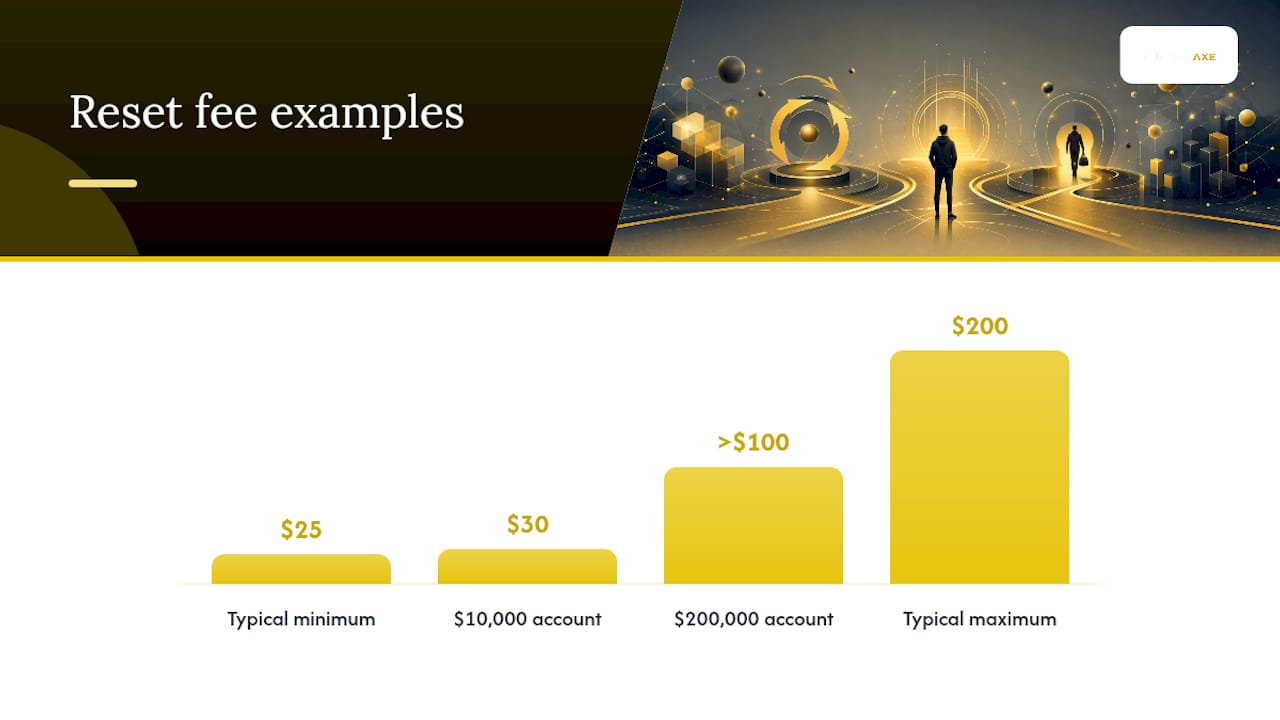
Fee structure. Expect somewhere between 30% and 60% of your original evaluation price, which in dollar terms usually lands between $25 and $200 depending on account size. A $10,000 account reset might run you $30. A $200,000 account reset can run well past $100. The percentage stays roughly consistent; the dollar amount scales with account size.
Caps and cooldowns. Most firms now cap resets at two to three per account and impose a waiting period between them, often 24 to 48 hours. This isn’t arbitrary friction. It’s a built-in circuit breaker against traders who reset immediately after a loss out of frustration rather than after actually diagnosing what went wrong.
Promotions and free windows. Some firms run limited-time free-reset promotions tied to launches or seasonal campaigns. These show up in email announcements or dashboard banners more often than in the permanent rules page, which means you have to check often if you’re timing a purchase around one.
Here’s the part that trips people up: reset pricing and promotions aren’t always static, and firms adjust them without a lot of fanfare. Package prices change, loyalty programs alter the effective cost, and a firm’s advertised reset fee on its marketing page can lag behind what’s actually charged at checkout.
Before you pay for a reset, check for:
- The exact reset fee for your specific account size, not a generic percentage
- Whether you’ve hit the firm’s reset cap already
- Any active promotion or loyalty discount that changes the price
- Whether the reset clause distinguishes between evaluation phases (a Phase 1 reset can price differently than a Phase 2 reset)
Read the firm’s terms of service page directly rather than relying on a support chat summary. Reset clauses live in the same document as drawdown definitions and violation consequences, and skimming just the FAQ tends to miss caps or exclusions buried in the full text.
Should you reset, buy new, or stop? A four-part diagnostic
Not every failed evaluation deserves the same response. Before you spend another dollar, sort your failure into one of four buckets. Specialist decision frameworks consistently point to this kind of categorization as the first real step, and it’s the one most traders skip in favor of just clicking “reset” out of habit.
- Execution error: you understood the rules and had a sound plan, but a fat-fingered order, a missed stop, or a platform glitch caused the breach. This is the strongest case for resetting, assuming you can point to the specific mistake and describe exactly how you’ll prevent it.
- Rule misunderstanding: you broke a rule you didn’t fully grasp, like a news-trading restriction or a weekend-holding clause. Contact support for clarification first. A reset without understanding the rule just sets up the same mistake for round two.
- Strategy variance: your edge is real over a large sample, but a short losing streak inside the evaluation window pushed you over a drawdown limit. This is a judgment call, and it usually depends on whether the evaluation’s time limit (or lack of one) gives your strategy room to recover.
- Structural or discipline failure: you’ve broken the same type of rule more than once, revenge-traded after a loss, or ignored your own sizing plan. This is the bucket where resetting rarely helps, because the account isn’t the problem.
Run three quick tests once you know your bucket. The economic test compares the reset fee against the price of a brand-new evaluation. If a reset costs $60 and a new evaluation costs $150, the reset wins on price alone unless you’re in bucket four. The behavioral test counts how many resets you’ve already paid for on this account; two or more with no verified fix is a red flag regardless of bucket. The operational test asks whether you’ve actually confirmed the fix works, not just assumed it will.
Concrete pre-reset actions worth taking every time:
- Reproduce your fix in a demo account for at least a few sessions before paying to reset
- Contact firm support directly if the violation involved a rule you’re unsure about
- Write down what happened and what you changed, even in a simple note, so you’re not relying on memory next time
Pro Tip: *Keep a one-line log every time you reset or fail an evaluation.
The risk math that decides whether your evaluation survives
Most evaluation failures trace back to drawdown mechanics that traders never fully worked out before they started trading real position sizes.
Static drawdown calculates your maximum loss from your starting balance and never moves. Trailing drawdown recalculates that floor upward every time your equity hits a new high. Bank a big early win on a trailing-drawdown account, and your cushion tightens right when you’d expect it to loosen. This is one of the most misunderstood mechanics in prop evaluations: traders assume a strong start buys them room, when a trailing structure can do the opposite.
Daily loss limits typically run between 4% and 6% of account balance, though this varies by firm and account tier. The practical fix isn’t to trade right up to that line. Set a personal daily stop at roughly 60% to 70% of the firm’s official daily loss limit, so a bad session ends your trading day well before the firm’s system does it for you.
The sizing math makes this concrete. On a $100,000 account with a 4% daily loss limit ($4,000), risking 1% per trade ($1,000) means four consecutive losing trades before you touch that ceiling. Set your personal stop at 65% of the limit, roughly $2,600, and you’re forced to step away after just two or three losses instead of grinding toward the firm’s actual boundary.
Time-of-day discipline matters more than most traders admit. Violations cluster around three moments: major news releases, the last few minutes before daily close-of-session resets, and late-session revenge trades after an earlier loss. Risking no more than 1% to 2% per trade during high-volatility windows, and having a firm rule about trading through scheduled news events, prevents a huge share of otherwise avoidable breaches.

The reset protocol: cooling off, root cause, and re-entry
A reset only works if you actually change something before you pay for it. This protocol gives that change a real chance.
- Cool off for 24 hours. Don’t reset the same day you fail. Industry practitioners consistently recommend a mandatory waiting period, because a reset purchased in the heat of frustration almost always repeats whatever just went wrong. Twenty-four hours is enough time to move from “that firm’s rules are unfair” to “here’s what I actually did.”
- Run the root-cause checklist. Was it technical (platform, execution), a rule you misread, a sizing and discipline lapse, or a mismatch between your strategy and the account’s structure (like a trailing drawdown punishing a strategy built for static)? Name it specifically.
- Verify the fix before you pay. Trade the same setup on a demo account for a stretch first, ideally covering several sessions that include at least one losing streak, so you can confirm the fix holds under pressure and not just on paper. A tool like Ciphora can help you review your trade history and spot the pattern you’re trying to break.
- Re-enter staged, not full-speed. Cut your position size in half for the first week back. Set a personal daily stop tighter than your usual 60 to 70% threshold. Scale back to normal size only after a full week without a rule breach.
Pro Tip: If you can’t reproduce your fix on a demo account within a few sessions, you haven’t actually found the fix. Don’t pay for a reset until you can.
Three scenarios that show the reset math in action
Scenario A: news-driven one-off. A trader on a $50,000 evaluation gets stopped out by a surprise rate decision that spiked spreads past their stop. New evaluation: $130. The reset wins by $90, and the failure wasn’t behavioral. This is the textbook case for resetting.
Scenario B: execution error, fix verified. A trader on a $100,000 account fat-fingered a lot size and doubled intended risk, tripping the daily loss limit. They confirmed on demo for a few sessions that a hard-coded position-size check prevents the error. Reset fee: around $80. New evaluation: $250. Reset saves $170, and the fix is verified, not assumed.
Scenario C: repeated discipline failure. A trader has reset the same $25,000 account three times in six weeks, each time after revenge trading post-loss. Cumulative reset fees: roughly $135. A demo review plus a fresh evaluation would run about $110, cheaper than the resets already spent and without the entrenched pattern of returning to the same account and repeating the same behavior. This is the stop signal. Time to practice on demo, rebuild the process, and consider whether the strategy itself needs work before spending another dollar with any firm.

The pattern across all three: quantify the fee gap, be honest about which bucket you’re in, and let the math and the behavior count both weigh in before you decide.
Where FundedAxe fits into the reset decision
FundedAxe’s evaluation structure changes some of the calculus above in the trader’s favor. Every FundedAxe challenge runs on static drawdown, not trailing, which means a strong early run doesn’t tighten your future risk tolerance the way it does on trailing-drawdown accounts. There’s also no time limit on any phase, no consistency rule to trip over, and news trading, weekend holding, and EAs are all allowed, which removes several common causes of accidental rule violations.
Pay After Pass lowers the cost of finding out whether your fix actually works: you start an evaluation for $9.99 and only pay the full challenge fee once you pass, which changes the reset-versus-repurchase math considerably compared to paying full price upfront on every attempt. If you’re still diagnosing a strategy problem, FundedAxe’s free $1,000 simulated trial account, no card required, gives you a place to test a fix without any fee attached at all.
Before paying for another reset anywhere, it’s worth comparing what a fresh start actually costs across different structures.
— Jean
Compare packages before you pay for another reset
FundedAxe is built around the idea that you shouldn’t have to gamble full price on an evaluation before proving you’re ready. Pay After Pass means you start for $9.99 and only pay the rest once you actually pass, which is a very different bet than a traditional upfront challenge fee.

If you’re weighing a reset against a fresh attempt, the smartest move is to run the numbers side by side. Static drawdown removes the trailing-drawdown trap entirely, no time limit takes the clock pressure off, and the free $1,000 trial account lets you test a fix before you commit a dollar to a real evaluation. Visit the package comparison page to see fees and rules for every account size side by side, or start the free trial today to confirm your strategy holds up before you pay for anything at all.
Where to verify the reset rules that actually apply to you
Firm-specific reset clauses live in the terms of service, not in marketing pages or third-party summaries, so read that document directly before assuming a policy applies to your account.
- Check your firm’s ToS or rules dashboard for the exact reset fee, cap, and cooldown tied to your account size
- Review CFTC guidance on contract obligations for background on how trading contracts and disclosures generally work
- See CFR Title 17, Section 4.41 for the federal regulatory context around trading performance disclosures
- Confirm current pricing and promotions through your account dashboard or support, since fees and caps change without much notice
Sources
- Prop Firm Account Resets: When to Reset, When to Restart — ThePropFirmGuide
- Prop Firm Evaluation Strategy — NexusFi Academy
- Prop Firm Account Resets: When to Reset vs Let Die — Copilink
- Understand contract obligations — CFTC