

Traders: $9.99 Risk, Verify Prop Firm Negative Balance Protection

In most funded-challenge models, you are not personally liable for trading losses. The real money you risk is the evaluation fee and any paid add-ons, not the balance on the account itself. Simulated capital plus maximum drawdown and daily loss limits are built to stop the account before losses turn into debt. The exception worth knowing: firm insolvency or vague contract language can still leave you exposed on unpaid payouts.
TL;DR:
- Losses during funded challenges are limited to the evaluation fee or nonrefundable add-ons, with no risk of owing real money beyond that amount.
- Automated limits like maximum drawdown and daily loss caps close your account instantly when breached, preventing any actual debt or negative balance.
- The primary risk of unpaid payouts arises from firm insolvency, where trader claims become unsecured debts, especially if the firm lacks transparent escrow or payout history.
- Static drawdown rules keep your dollar buffer consistent regardless of account growth, making position sizing risk management crucial before trading.
- Verifying a firm’s payout history, jurisdiction, and clear contractual terms helps protect against uncollectible rewards or undisclosed risks in the event of firm failure.
Table of Contents
- How Negative Balance Protection Works at Prop Firms
- What Actually Happens When You Blow an Account?
- What to Check in the Trader Agreement
- When Doesn’t the Protection Hold Up?
- What Does Negative Balance Protection Mean at a Prop Firm?
- How Do Negative Balance Policies Compare Across Prop Firms?
- How Should Negative Balance Rules Shape Your Risk Strategy?
- Are There Legal Protections Specific to Prop Trading?
- What Do Real Negative Balance Incidents Look Like?
- A Straight Answer on Risk, and a Short Checklist
- How FundedAxe Handles Loss Containment and Upfront Risk
- Where to Verify These Rules Yourself
- Sources
- FAQ
How Negative Balance Protection Works at Prop Firms
Almost every retail prop firm hands you a simulated funded account, not real trading capital. You’re trading a live market feed against a number in a database that the firm controls entirely. That distinction is the whole reason negative balance risk essentially disappears in this business model: there’s no real client capital to lose, so there’s no real debt to create.
The mechanism that actually enforces this is automated, not discretionary. Two numbers do the work:
- Maximum drawdown: a hard floor on the account, expressed as a percentage or dollar figure below the starting balance.
- Daily loss limit: a separate cap on how much the account can lose in a single trading day before it’s frozen.
When either line gets touched, the platform closes the account automatically. No phone call, no negotiation, no invoice. Drawdown and daily-loss limits function as the operational brake that keeps a bad trading day from becoming a bad month.
Here’s where the money actually changes hands: you pay the evaluation fee upfront (or after passing, depending on the model), and that fee is the firm’s revenue if you fail. The trading losses themselves are just numbers on a simulated ledger the firm absorbs. Some prop firms use static, balance-based drawdown rather than a trailing calculation, impose no time limit on any phase, and allow expert advisors and algorithmic trading. None of that changes who owns the loss; it changes how much room you have to trade before the account, not your wallet, takes the hit.
Pro Tip: Before you fund an account, calculate your max dollar drawdown in real terms. Knowing the number in dollars, not just percent, changes how you size positions.
For a deeper look at how drawdown limits should shape your position sizing, see how to think about risk per trade on a funded account.
What Actually Happens When You Blow an Account?
Losing a funded account feels dramatic in the moment. Financially, it’s usually a lot smaller than it feels.
- You lose the fee, not a fortune. The evaluation or challenge fee is the ceiling on your tangible loss. Industry reporting is consistent on this point: traders don’t get billed for the simulated losses racked up during the challenge.
- You lose access, not equity. Breach the drawdown or daily limit, and the platform locks you out. Any unpaid profits sitting in the account at that point are typically forfeited, along with loyalty perks tied to that specific account.
- You lose momentum, but you have options to restart. Most firms offer some path back in: a discounted retry, a fresh challenge purchase, or a free simulated trial account with no card and no deposit required, useful for testing a strategy adjustment before spending real money again.
The model that changes this math the most is Pay After Pass. Instead of paying the full challenge fee upfront, you pay $9.99 to start, then the remaining base fee of $515.01 only if you actually pass. That flips the order of financial risk: you’re not fronting hundreds of dollars against an unknown outcome, you’re fronting ten.
None of this changes the underlying protection mechanism. It changes how much of your own money is exposed while you find out whether the strategy works.
What to Check in the Trader Agreement
Rules are only as good as the paper they’re written on, and every prop firm writes its own paper. Before you pay anything, pull four documents: the trader agreement, the funded-account terms, the risk disclosure, and the general terms of service. Read them in that order, because the trader agreement usually governs everything else.
Look for specific words, not vague reassurance:
- “Simulated” or “virtual capital” — firms that disclose this explicitly are telling you plainly that no real capital is at risk in trading.
- “Maximum drawdown” and “daily loss limit” — check whether these are static (fixed against the starting balance) or trailing (recalculated as the balance grows).
- “Payout custody” — this tells you how the firm holds funds earmarked for trader payouts, and whether they’re separated from operating cash.
- “Force majeure” — a broad version of this clause can let a firm delay or deny payouts under loosely defined circumstances.
- Refund or refund-on-payout language — does the fee come back, and under what condition?
If any of this reads ambiguous, don’t guess. Email support and ask directly: “Is trading capital on this account simulated or real, and where does that appear in the agreement?” Save the reply. A support answer in writing is worth more than a marketing page.
Pro Tip: Screenshot the specific clause, not just the page title. Firms update terms of service, and a screenshot with a visible date and URL is your proof of what you agreed to. For a plain-language walkthrough of common clauses, this breakdown of what a trader agreement actually locks you into is a useful reference, and the prop trading glossary helps if any of the terminology is unfamiliar.
When Doesn’t the Protection Hold Up?
Drawdown limits protect you from trading losses. They do nothing for you if the firm itself runs out of money.
If a prop firm becomes insolvent, approved but unpaid payouts are often gone for good. Traders typically sit in the unsecured creditor line, behind landlords, vendors, and anyone with a lien. There’s usually no segregated account holding your earned payout separately from the firm’s operating funds, which is exactly what protects a broker’s retail client under most regulatory regimes.
That gap matters because broker-style protections like segregated client funds don’t transfer automatically to prop-firm structures. A prop firm isn’t a regulated broker holding your deposit; it’s a private company owing you a performance based reward. Those are legally different relationships, even when the trading screen looks identical.
Before you commit serious money to any evaluation, look for a handful of signals:
- Explicit escrow or segregated trust language for payout funds, not just a promise to pay.
- Clear disclosure of the firm’s operating jurisdiction.
- A visible payout history or public track record of paying traders.
- A trader agreement you can read before purchase, not one revealed only after checkout.
Statistic Callout: Recovery odds after a prop-firm collapse are jurisdiction-dependent and often uncertain even when the firm previously paid other traders on time, because contracts labeling funds as virtual or simulated typically classify unpaid profit claims as unsecured debt.
Start small with a new firm. Use a trial account first, stagger your purchases instead of buying the largest account size on day one, and treat a clean payout history as the single best predictor of future payouts.
What Does Negative Balance Protection Mean at a Prop Firm?
In the retail brokerage world, negative balance protection means your account can’t go below zero, so you never owe the broker money on a margin blowout. At a prop firm, the concept shows up differently because the mechanics are different from the start.
A prop-firm evaluation or funded account is almost always simulated. You never had real capital that could go negative in the first place, so there’s no balance to protect in the broker sense. What functions as protection here is the combination of maximum drawdown, daily loss limits, and automated account closure. Breach a limit, and the system shuts the account before losses can theoretically exceed the buffer built into the rules.
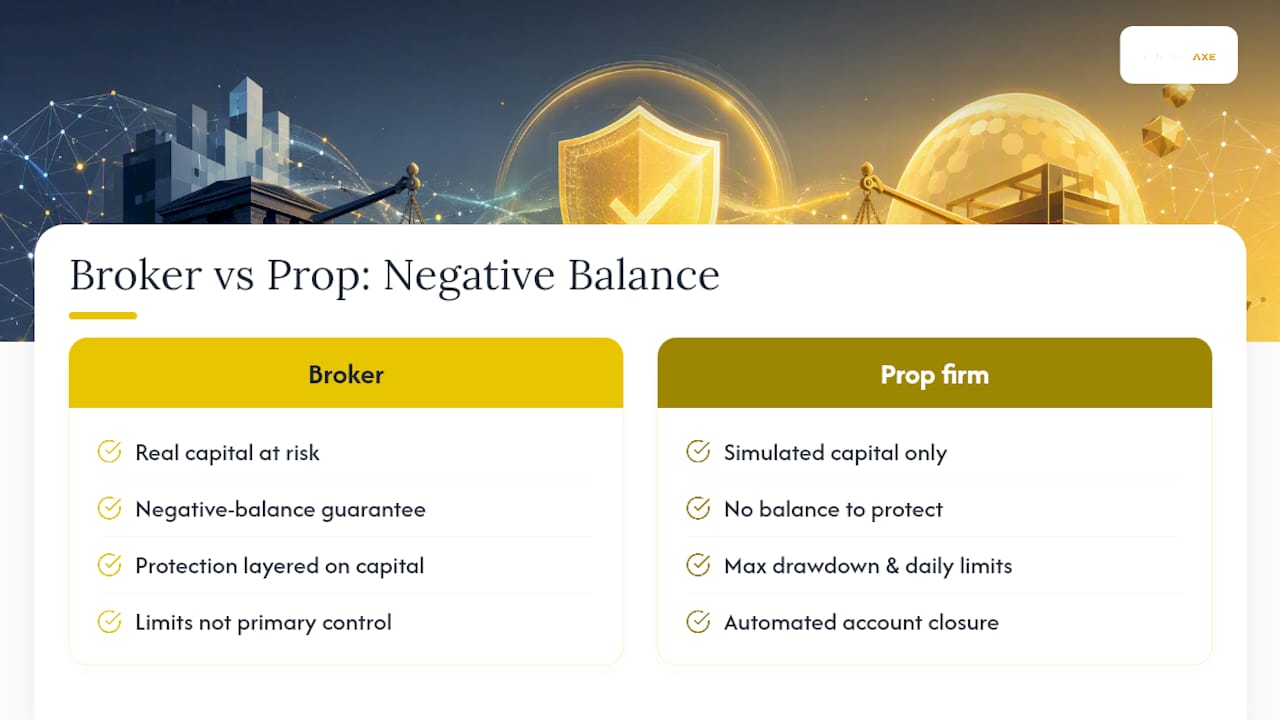
The practical effect for you is the same outcome brokers advertise: you cannot end up owing the firm money for trading losses. But the reason is structural rather than regulatory. A broker offers negative balance protection as a guarantee layered on top of real capital at risk. A prop firm avoids the problem entirely by never putting real trading capital at risk to begin with. Understanding that difference matters if you’re comparing marketing language across firms, because “protected” can describe two genuinely different arrangements depending on who’s making the claim.
How Do Negative Balance Policies Compare Across Prop Firms?
Nearly every retail prop firm running simulated accounts arrives at the same basic policy, even if the wording varies: trading losses stay inside the simulated account and never become a bill sent to the trader. The consistency comes from the business model itself. Fees fund the firm’s revenue; simulated losses are an internal bookkeeping event.
Where firms actually differ is in the type of drawdown rule they apply, and that difference changes how much room you have before the automated shutdown kicks in.
| Drawdown type | How it’s calculated | Practical effect |
|---|---|---|
| Static (balance-based) | Fixed against the starting balance, never moves | Your buffer stays the same dollar amount even after profits |
| Trailing | Recalculated as your balance rises | Your buffer can shrink in dollar terms as you bank gains |
FundedAxe uses static drawdown across its evaluations, which means a trader who grows a $100,000 account to $108,000 still has the same dollar buffer they started with, not a smaller one recalculated against the new peak. That’s a meaningfully different risk profile than a trailing structure, even though both firms would describe themselves as offering loss containment.
Time limits are the other variable worth flagging. Some firms impose minimum trading days or hard deadlines on each evaluation phase, which pressures traders into rushed decisions near a limit. Rules with no time limit on any phase remove that particular pressure, though the drawdown and daily loss ceilings still apply regardless of how long you take.
How Should Negative Balance Rules Shape Your Risk Strategy?
Knowing your maximum tangible loss is capped at the fee changes how you should actually trade, not just how you should feel about trading. Too many applicants trade a funded evaluation like it’s a real account with a real loss on the line, which usually leads to either overcaution or the opposite mistake: reckless sizing because “it’s not real money anyway.”
Neither instinct serves you well. The better frame is to treat the drawdown limit as your actual account, because functionally it is. If a $100,000 evaluation carries a $10,000 static drawdown, that $10,000 is your trading capital in every sense that matters for risk management. Position sizing, stop placement, and daily loss budgeting should all be built against that number, not against the headline account size.
This is also where daily loss limits change strategy more than most applicants expect. A firm that caps daily losses forces discipline that a personal account might not: you physically cannot revenge trade your way through a bad session past a certain point, because the system locks you out. Traders who build their approach around that ceiling from day one, rather than discovering it mid-drawdown, tend to make it through evaluations more consistently. For a breakdown of how to translate a firm’s drawdown percentage into a per-trade risk figure, this guide on risk limits and the 0.5% to 1% math walks through the calculation directly. Firms that also allow expert advisors and algorithmic strategies add another layer: automated systems can enforce your personal risk rules more consistently than manual discipline usually manages.
Are There Legal Protections Specific to Prop Trading?
Prop-firm challenges mostly operate in a regulatory gray zone compared to retail brokerage. A broker holding client deposits typically falls under specific rules requiring segregated client funds, and in some jurisdictions, compensation schemes that kick in if the broker fails. A prop firm selling simulated evaluations generally isn’t structured as that kind of regulated custodian, because it never holds client trading capital in the first place.
That absence of a regulatory framework doesn’t mean prop firms operate outside contract law. Your protection, such as it is, comes almost entirely from the trader agreement you sign and the enforceability of that contract in the firm’s stated jurisdiction. If a firm discloses simulated capital clearly, states its payout terms plainly, and operates transparently about where it’s based, you have a contract to point to if something goes wrong. If any of that is missing or buried, you have far less recourse than a broker’s client would.
This is also why jurisdiction transparency matters more than people assume when applying. A firm based somewhere with weak contract enforcement, or one that doesn’t disclose its operating jurisdiction at all, gives you fewer practical options if a payout dispute arises. None of this is about finding a firm with a specific regulatory license the way you’d check a broker’s registration. It’s about confirming the firm has a real, enforceable agreement and a track record that suggests it honors that agreement consistently.
What Do Real Negative Balance Incidents Look Like?
The clearest illustration of “protected” versus “unprotected” outcomes isn’t hypothetical. It’s the difference between a trader who blows a simulated evaluation and one who gets caught in a firm collapse with unpaid rewards on the table.
In the contained scenario, a trader breaches a daily loss limit on a funded account. The platform locks the account automatically. The trader’s loss is the fee paid to enter the evaluation, nothing more. No collections call follows, because there was never real capital at risk to begin with, only a simulated balance the firm absorbed internally. That’s the outcome the vast majority of retail prop-firm traders experience, and it’s exactly what the drawdown mechanics are designed to produce.
The uncontained scenario looks different, and it’s the one traders underestimate. A trader passes an evaluation, trades a funded account successfully, and has a reward approved but not yet paid when the firm hits financial trouble. Because the account was simulated and the firm held no segregated payout fund, that approved reward becomes a claim against a company that may not have the cash to honor it. The trader isn’t the priority creditor in that situation, and recovery, if any comes at all, can take months or years through whatever legal process the firm’s jurisdiction allows.
The lesson isn’t that funded challenges are dangerous. It’s that the risk profile has two completely different faces: contained trading loss on one side, uncontained payout risk on the other. Reading a firm’s payout history and jurisdiction disclosure before committing serious capital to an evaluation addresses the second risk directly, since nothing about drawdown rules touches it at all.
A Straight Answer on Risk, and a Short Checklist
Most of the fear around funded challenges comes from a misunderstanding of where the real risk sits. Traders worry about the trading itself, when the actual exposure is almost entirely contractual: what happens to an approved payout if the firm can’t pay it, and whether the agreement you signed gives you any real footing if that happens. The trading mechanics, drawdown, daily loss limits, simulated capital, are honestly the boring part. They work as advertised in the overwhelming majority of cases. The interesting risk, the one worth your actual attention, lives in the fine print and in the firm’s financial health, not in your stop losses.
If you’re applying to a challenge, run this three-part check before you pay anything:
Readiness: do you have a tested strategy and defined risk controls, or are you hoping the challenge itself will teach you discipline? Paperwork: have you actually read the drawdown, payout, and force majeure clauses, or are you assuming they say what every other firm’s terms say? Funding plan: what’s your real tolerance for losing the evaluation fee, and does that number match what you’re about to spend?
Some prop firms publish their rules and simulated funded account structures openly, allowing verification before committing any money.
— Jean
How FundedAxe Handles Loss Containment and Upfront Risk
FundedAxe is built around one specific idea: your upfront risk should match your actual chance of passing, not the firm’s revenue target. That’s the entire logic behind Pay After Pass, where you start an evaluation for $9.99 and only pay the remaining $515.01 base fee once you’ve actually passed, instead of fronting hundreds of dollars against an unknown outcome.

Certain proprietary trading accounts, evaluation or funded, are disclosed as simulated, with static drawdown rules and no minimum trading days on any phase, so the loss-containment mechanics discussed herein apply concretely to those applicants. If you want to see how the numbers stack up before spending anything, the package comparison page lays out account sizes, fees, and drawdown terms side by side across the 1-step, 2-step, and 3-step options.
Not ready to risk even $9.99 yet? Open the Free1K trial account, a simulated $1,000 account with no card and no deposit required, and test the platform’s rules and your own strategy before committing a dime.
Where to Verify These Rules Yourself
Don’t take any firm’s marketing copy at face value, including this article’s. Pull the actual risk disclosure and trader agreement before you pay for an evaluation anywhere. For outside context on how “protection” gets used across trading products generally, this breakdown of cash flow protection concepts and this plain-language explainer on central bank balance sheets are useful background reading, even outside the prop-firm context specifically.
This article is general information, not a substitute for advice from a qualified financial advisor. Consult a qualified financial professional about your own circumstances before acting on anything here.
Sources
- Simulated Capital vs Real Capital: How Prop Firms Actually Work (2026)
- Do Prop Firms Keep Your Losses? What Actually Happens (2026)
- Prop Firm Collapse and Account Protection: What Every Funded Trader Must Know - NexusFi Academy
- What happens if you lose a funded account? | FTO
FAQ
Does Negative Balance Protection Apply to Prop-Firm Challenges?
Not in the broker sense of guaranteeing a live account can’t fall below zero. Prop-firm evaluations typically use simulated capital, so there’s no real balance to protect, and drawdown limits close the account before losses exceed the built-in buffer.
What’s the Maximum Amount I Can Actually Lose?
Your real financial exposure is capped at the evaluation fee you paid, plus any nonrefundable add-ons purchased at checkout. With FundedAxe’s Pay After Pass, that starting exposure is $9.99 until you pass.
Can a Prop Firm Come After Me for Trading Losses?
No, in the standard simulated-account model, firms absorb trading losses internally rather than billing traders for them. Read the trader agreement to confirm the account is explicitly labeled simulated before you assume this applies to any specific firm.
What Happens to My Payout If the Firm Goes Bankrupt?
Approved but unpaid payouts are often difficult or impossible to recover because traders typically rank as unsecured creditors with no segregated fund backing their reward. Checking a firm’s payout history before committing capital is the best available safeguard.
How Much Does a FundedAxe Evaluation Cost?
FundedAxe’s Basic 1-Step $100,000 account costs $455 upfront, while Pay After Pass starts at $9.99 with the remaining $515.01 due only after passing. Full pricing across account sizes and evaluation types is listed on the package comparison page.
Recommended
Educational content only, not financial advice. All FundedAxe accounts use simulated funds. No strategy guarantees a return.