
Prop Firm Add-Ons: Which Ones Are Worth the Money

Three add-ons move the needle for most traders: profit-split upgrades, weekend-hold or news-trading rule removals, and faster payout cadence. The rest are convenience purchases that rarely change your outcome.
The order you buy them in matters more than the list itself. If a rule conflicts with how you trade (you hold trades over the weekend, you trade around Nonfarm Payrolls), fix that first, since a rule violation ends your account regardless of what your profit split looks like. Payout-frequency and profit-split upgrades come next, and only once you’ve proven you can pass a challenge and get paid consistently.
- Rule-removal add-ons (weekend holding, news trading, no minimum days): buy these only if your strategy actually needs them.
- Payout-frequency upgrades: worth it once you’re generating regular profits and want cash sooner.
- Profit-split boosts: the last purchase, not the first, unless you’re already funded and cashing out regularly.
Key Takeaways
Rule-removal add-ons protect your ability to trade your actual strategy, while profit-split and payout upgrades only pay off once your results are already consistent.
| Point | Details |
|---|---|
| Buy rule fixes first | Weekend holding and news-trading removal matter most when your strategy already conflicts with default rules. |
| Profit splits pay off fast | A 10-point split upgrade on a $50,000 account can break even in under a month at $2,000 monthly profit. |
| Add-ons rarely raise pass rates | Only rule-removal add-ons affect evaluation outcomes; payout and split upgrades apply after you’re funded. |
| Check refund terms first | Add-on purchases are often final sale, so confirm the refund and support policy before checkout. |
| Fundedaxe ties pricing to results | Pay After Pass, news and weekend trading by default, and a transparent up-to-100% split add-on avoid forcing upgrades before you’ve passed. |
Table of Contents
- What Prop Firm Add-Ons Actually Are
- How Each Add-On Changes Your Rules and Risk
- Is the Profit-Split Upgrade Worth It? The Math
- Do Add-Ons Improve Your Pass Rate?
- How to Pick the Right Add-Ons for Your Style
- Why Firms Sell Add-Ons in the First Place
- Refund and Support Policies Traders Overlook
- What Add-Ons Change in Practice
- Where FundedAxe Fits If You Want Straight Answers on Add-Ons
- Frequently Asked Questions
- Sources
What Prop Firm Add-Ons Actually Are
A prop firm add-on is a paid, optional modification to a firm’s default challenge or funded-account rules. Instead of accepting the standard terms, you pay extra to remove a restriction, unlock a feature, or accelerate a payout. Common categories include profit-split upgrades (often 80% to 90%), weekend holding, news-trading removal, no-minimum-trading-days, consistency-rule removal, leverage increases, swap-free conversion, and account reset or insurance. Add-ons typically run $20 to $150 each, and firms often bundle three to eight of them at checkout to lift average order value.
| Add-on | Typical cost | Best for (style) | Primary benefit | Stage it applies to |
|---|---|---|---|---|
| Profit-split upgrade (e.g., 80% → 90%) | Typically priced within a moderate range | Any style, post-pass | Higher payout per cycle | Funded |
| Weekend holding | $20–$50 | Swing traders | Rule removal | Evaluation and funded |
| News trading removal | $20–$50 | Day traders, news traders | Rule removal | Evaluation and funded |
| Payout frequency upgrade | Typically priced within a moderate range | Active, cash-flow sensitive | Faster access to profits | Funded |
| Leverage increase | Typically priced within a moderate range | Scalpers | Bigger position sizing | Evaluation and funded |
| No-minimum trading days | $20 to $50 | Fast, confident traders | Speed to funded | Evaluation |
| Reset/insurance | $50–$150 | First-time challenge takers | Second attempt without repurchase | Evaluation |
| Swap-free | $20 to $50 | Traders avoiding overnight interest | Compliance/convenience | Both |
Consistency-rule removal usually sits in the same $20 to $50 band and matters most for traders whose monthly results are lumpy rather than steady.
How Each Add-On Changes Your Rules and Risk
Every add-on is a rule swap, and each swap changes what kind of trade you’re allowed to place and how much risk you’re carrying while you place it.
Weekend holding is the clearest example. Without it, a standard rule forces you to flatten positions before Friday’s close. If you swing trade EUR/USD off a daily chart and your setup needs three or four days to play out, that forced flat is a strategy killer. It doesn’t just cost you a trade, it actively works against your edge. Add the option, and a Thursday entry can run through Monday’s open without penalty.

News trading removal works the same way for a different crowd. Many evaluations restrict trading within a set window around high-impact releases like CPI or the Fed rate decision. If your entire approach is fading the spike after Nonfarm Payrolls, that restriction disqualifies your method outright unless you buy the removal.
Leverage increases carry the sharpest behavioral risk. Bumping leverage from 1:30 to 1:100 doesn’t change your edge, it changes your exposure per trade. A scalper running the same position size on higher leverage sees faster drawdown swings in both directions, and pass-rate analysis suggests traders who stack leverage without adjusting position size fail challenges faster, not slower.
Profit-split upgrades create a subtler problem: risk creep. Once a trader knows they’re keeping 90% instead of 80%, some start sizing up “since the split is better now,” which defeats the purpose of the upgrade before the first payout even lands.
No-minimum-trading-days removal helps traders who pass fast and don’t want to sit on a winning evaluation waiting out an artificial calendar requirement. It has no bearing on your actual edge, it just removes a delay.
Third-party tools sometimes cover ground a firm add-on charges for. Multi-account terminals like PropTerminal give power users OCO brackets and per-account risk controls that some firms only offer as a paid convenience layer, and platforms like TradingView let you build the strategy testing and scripting that some “convenience” add-ons are really just wrapping.
Pro Tip: Before buying a rule-removal add-on, pull up your last 20 trades and check how many would have violated the default rule. If the answer is fewer than two or three, you probably don’t need it yet.
Is the Profit-Split Upgrade Worth It? The Math
Run the numbers before you buy a split upgrade, not after.
Take a $50,000 funded account generating $2,000 in monthly profit. At an 80% split, you keep $1,600. Upgrade to 90% for a one-time $80 fee, and you keep $1,800, a $200 monthly gain. That upgrade pays for itself in under a month. On a $200,000 account generating $6,000 monthly, the same 10-point split lift adds $600 a month against a typical $100 to $150 upgrade fee, break-even inside a week.
The formula scales down just as easily: (net percentage gain × expected monthly payout) ÷ add-on cost = months to break-even.
| Account size | Monthly profit | Split upgrade cost | Extra kept per month | Break-even |
|---|---|---|---|---|
| $50,000 | $2,000 | $80 | $200 | Under 1 month |
| $200,000 | $6,000 | $100 to $150 | $600 | Under 1 week |
Faster payouts follow the same logic but reward cash flow instead of raw dollars. Moving from monthly to bi-weekly payouts on a consistently profitable account doesn’t add money, it gets you the same money roughly two weeks sooner every cycle. If a $50 add-on saves you two weeks of waiting on a $1,600 payout, most traders managing cash flow tightly will call that worth it. PropFirmScan’s guide notes profit-split upgrades typically need several consistent payout cycles to justify the premium if your monthly output is smaller or irregular.
Do Add-Ons Improve Your Pass Rate?
Most add-ons don’t touch your pass probability at all. They change what you keep after you pass, not whether you pass.
Rule-removal add-ons are the exception. Weekend holding, news-trading removal, and no-minimum-trading-days directly prevent the kind of rule violation that fails an evaluation outright, so when they match your strategy, they’re closer to essential than optional. Profit-split upgrades, payout-frequency changes, and swap-free conversion sit entirely on the funded side. They affect what happens after you’re already trading real allocated capital, not your odds of getting there.
Buying a profit-split upgrade before you’ve proven you can pass a challenge is like negotiating your bonus before you’ve gotten the job. It solves a problem you don’t have yet, and it does nothing about the rule violation that’s actually going to end your account.
- Weekend holding: essential if you swing trade, irrelevant if you close every position intraday.
- News trading removal: essential for news traders, a non-issue for anyone who avoids high-impact windows anyway.
- Profit split and payout frequency: valuable only once passing and getting paid is routine.
How to Pick the Right Add-Ons for Your Style
Run through this before checkout, not after:
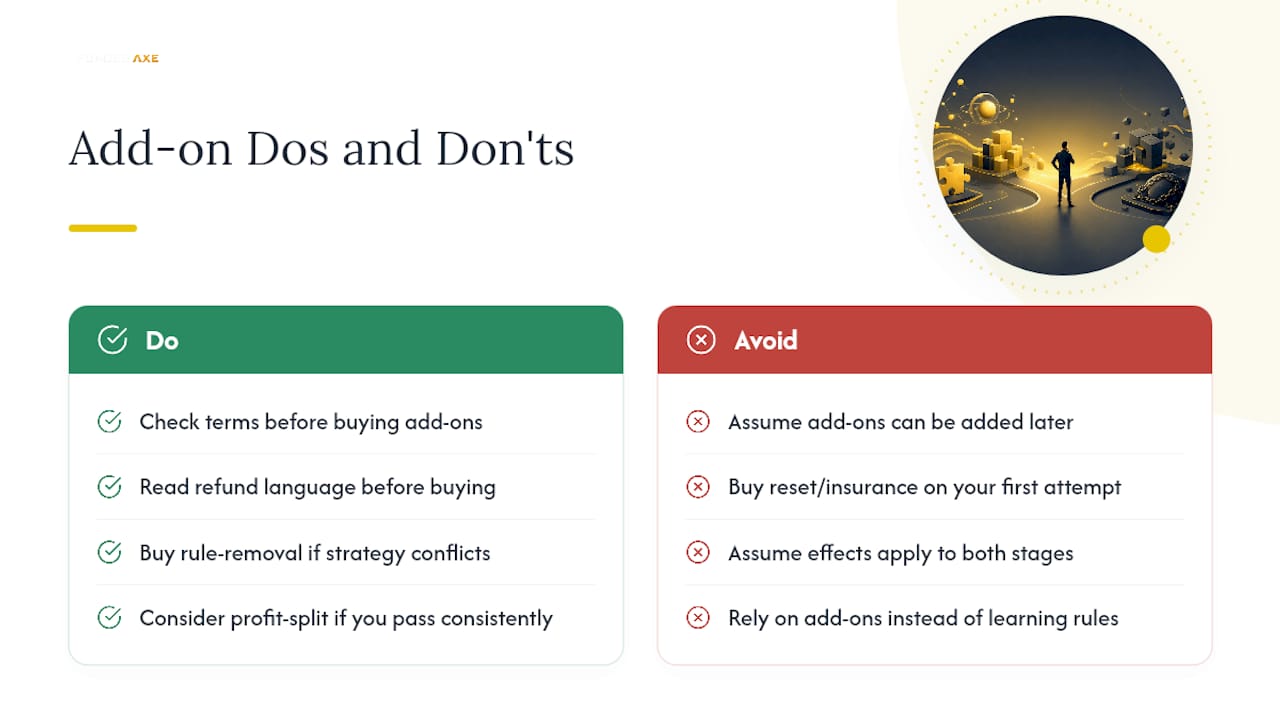
- Does the default rule conflict with a trade I make regularly? If yes, that’s your first purchase.
- Am I buying this for the evaluation, the funded account, or both? Some add-ons only apply at one stage.
- What’s the incremental payout versus the cost? Run the break-even math from the section above before paying for a split or payout upgrade.
- Is this firm transparent about what the add-on changes? Vague descriptions are a red flag.
- Skip reset or insurance add-ons on your very first challenge unless you have a track record of failing similar rules elsewhere.
- Never buy a profit-split boost before you’ve passed at least once, since it solves the wrong problem.
- Fix rule conflicts first, cash-flow second, profit split last.
For a broader look at how challenge structure interacts with these choices, how prop firm challenges work breaks down evaluation versus funded stages in more detail.
Why Firms Sell Add-Ons in the First Place
Add-ons exist because they lift average order value with minimal added cost to the firm. A $50 challenge fee becomes a $90 checkout once a trader adds two or three convenience upgrades, and affiliate-side data treats add-on revenue as a separate, deliberately optimized line item.
- Checkout design often highlights the add-ons that carry the highest margin, not necessarily the ones most traders need.
- Affiliate commission structures can push certain bundles harder than others, independent of trader fit.
- Reviewer feedback on firms like FXIFY and InstantFunding shows add-on prominence at checkout directly affects how transparent a firm feels to buyers.
Check refund and support terms before buying. A firm that’s vague about what an add-on does, or slow to answer support questions about it, is telling you something about how it’ll handle a payout dispute later.
Refund and Support Policies Traders Overlook
Most add-on purchases are treated as final sale the moment the challenge starts, which is different from how refunds work on the base challenge fee itself. Read the specific terms before checkout, not after a problem shows up.
Ask three questions before paying for any add-on. First, is the add-on refundable if you fail the evaluation immediately after buying it? Many firms say no, since the rule change was already applied to your account regardless of outcome. Second, does support treat add-on questions with the same priority as account-access issues, or does it route to a slower queue? Third, is there a written policy anywhere, or does the answer only come from a chat agent with no documentation to point to?
Firms that publish clear, specific refund language for both challenge fees and add-ons tend to handle disputes better because the terms are set before money changes hands, not negotiated after a trader is already upset. Vague policies buried in a general terms-of-service page are a warning sign, not a technicality.
Support responsiveness matters more for add-ons than it might seem, since a rule-removal add-on that doesn’t apply correctly to your account (a weekend-hold add-on that still triggers a violation, for instance) needs fast resolution before it costs you the challenge. Slow support on a fast-moving rule dispute is the difference between a fixable error and a failed account.
What Add-Ons Change in Practice
Consider two realistic trader profiles to see how the math and rules actually play out.
A swing trader running a $100,000 evaluation holds three to five trades a week, often into the weekend, on major currency pairs. Without the weekend-hold add-on, the standard forced-flatten rule would have closed two profitable positions early over a six-week evaluation window, turning what should have been a pass into a marginal result. The $30 to $50 add-on cost is trivial against the evaluation fee itself, and it directly protects the trades the strategy depends on. This is the clearest case where a rule-removal add-on isn’t optional, it’s a prerequisite for the strategy to function at all.
Compare that to a day trader on a funded $50,000 account generating $1,800 a month who buys a profit-split upgrade from 80% to 90% for $80. The upgrade adds $180 a month in extra payout, breaking even in under two weeks. The profit split paid for itself. The leverage boost, bought without a plan to adjust sizing, nearly cost the account. Overtrading and unadjusted risk after a rule change is a known pattern, and it’s worth reviewing common overtrading triggers before adding any leverage-related upgrade.
A practical rule of thumb
I buy rule-removal add-ons only when they map directly to how I already trade, and I hold off on payout or profit-split upgrades until payouts are already consistent, not hoped for.
Where FundedAxe Fits If You Want Straight Answers on Add-Ons
Fundedaxe built its pricing around the same logic this article just walked through: pay for what actually changes your outcome, skip the rest. The Pay After Pass option lets you start an evaluation for $9.99 and only pay the remaining challenge fee once you’ve actually passed, which sidesteps the common trap of loading up on add-ons before you’ve proven you can clear the challenge at all.

Payouts can be requested every 14 days as standard, or every 7 days with the 7-Day Rewards add-on, and swap-free trading is available for traders who need it. There’s no time limit on any evaluation phase, which matters if you’re the swing trader from the example above and don’t want a clock working against your strategy. If you want to test the account structure before committing money, the free simulated $1,000 trial account requires no card and no deposit. Check current payout structures and reward splits to see how the cadence and split options apply to your account size.
Frequently Asked Questions
Can I add prop firm add-ons after I’ve already started my challenge? It depends on the firm. Some add-ons must be selected at checkout and lock in immediately, while others, like payout-frequency changes, can sometimes be added after you’re funded. Check the specific terms before assuming an upgrade is available mid-challenge.
Do add-ons apply to both the evaluation and the funded account, or just one? It varies by add-on. Rule removals like weekend holding and news trading typically apply to both stages once purchased, while profit-split and payout-frequency upgrades usually only take effect after you’re funded.
Are prop firm add-ons refundable if I fail the evaluation? Most firms treat add-ons as final sale once the challenge begins, separate from any refund policy on the base fee. Read the specific refund language before buying, since policies differ significantly across firms.
Should a first-time challenge taker buy a reset or insurance add-on? Generally, no. Reset and insurance add-ons make more sense after you’ve already failed once and understand which rule tripped you up. On a first attempt, that $50 to $150 is usually better spent understanding the base rules first.
What’s the single highest-value add-on for most traders? For traders whose strategy already conflicts with a default rule, weekend holding or news-trading removal delivers the most immediate value. For traders who already pass consistently, a profit-split upgrade tends to pay for itself the fastest.
This article is general information, not a substitute for advice from a qualified financial advisor. Consult a qualified financial professional about your own circumstances before acting on anything here.
Sources
- What is Prop Firm Add-On? | Affiliate Marketing Glossary | Track360
- PropTerminal - The Ultimate Multi-Prop Trader Swiss-Knife