

$9.99 Start: FundedAxe Rune Points And Prop Firm Loyalty Programs

Prop firm loyalty programs turn evaluation purchases, trading activity, and referrals into points that reduce future challenge fees or unlock upgraded account terms. They work best for traders who run multiple evaluations, take resets, or scale accounts over the course of a year. Someone buying a single challenge won’t see much benefit; someone cycling through three or four a year can meaningfully cut costs.
TL;DR:
- Traders who cycle through multiple evaluations and resets annually can significantly reduce costs through prop firm loyalty programs, while single purchasers see limited benefits.
- Most programs award points for purchases, trades, or referrals, with automatic tracking preferred to avoid disputes and manual claims requiring diligent recordkeeping.
- Tier levels generally offer permanent account condition upgrades, such as account management or coaching, rather than temporary discounts, adding long-term value.
- Redemption options like free evaluations or scaling credits require careful calculation of expiry dates and thresholds to ensure actual savings surpass marketing claims.
- Loyalty points often expire within 6 to 12 months of inactivity, and incentives like increasing trading volume for points can influence trader behavior beyond cost considerations.
Table of Contents
- What Are Prop Firm Loyalty Programs, Exactly?
- How Do You Earn Points in a Prop Firm Program?
- How Do You Claim and Track Your Points?
- What Do Tier Levels and Their Perks Actually Look Like?
- How Do You Redeem Points for Real Savings?
- A Step-by-Step Checklist Before You Rely on Loyalty Credits
- How Does FundedAxe’s Loyalty Program Work?
- How Do Loyalty Programs Compare Across Prop Firms?
- Do Loyalty Programs Change How Traders Actually Trade?
- How Do Loyalty Perks Interact With Risk Management Rules?
- What Are the Downsides of Prop Firm Loyalty Programs?
- Why Loyalty Programs Matter More Than Discount Codes Now
- Try Pay After Pass and Start Earning Rune Points Today
- Sources
- FAQ
What Are Prop Firm Loyalty Programs, Exactly?
The mechanics borrow directly from retail loyalty schemes, but the redemption side is trading specific. Instead of cashback on groceries, you get discounts on evaluation fees, free resets, or account upgrades.
Three components define almost every program on the market:
- Points or credits: earned through purchases, trades, or completed “missions” like referrals.
- Tiers: status levels that unlock better terms as your lifetime spend or activity grows.
- Redemption catalog: the list of things you can actually spend points on, from discount codes to free evaluation accounts.
Some firms have started calling this “loyalty rewards for prop firms” or “trader reward systems” in their marketing, but the underlying idea is the same as any airline or hotel program: reward repeat business, discourage switching to a competitor.
How Do You Earn Points in a Prop Firm Program?
Earning mechanics vary more than most traders expect, and reading the fine print matters before you assume a purchase or trade automatically counts.
- Purchase-based earning: a percentage of your challenge fee converts to points, similar to cashback. A $500 evaluation might return 5 to 10 points redeemable later.
- Trade-activity earning: some programs award credits per trade or per lot traded, regardless of whether you pass the evaluation. One reporting piece on the trend describes firms awarding loyalty credit for every trade placed, with accumulated credits redeemable against future evaluations, resets, or scaling.
- Missions and referrals: completing a profile, referring a friend, or hitting a trading milestone can add bonus points on top of normal accrual.
- Automatic vs. manual tracking: most modern platforms track points automatically inside your dashboard, but some legacy programs still require you to submit proof of purchase or trade history to claim credit.
That last distinction matters more than it looks. Automatic tracking means less friction and fewer disputes. Manual claims mean you need to keep receipts and screenshots, because “I forgot to upload it” is not a case most support teams will fight for you.
How Do You Claim and Track Your Points?
Checking and claiming points should be routine, not a monthly scavenger hunt. Here’s a practical sequence:
- Log into your trader dashboard and check the loyalty or rewards tab weekly, not just when you’re about to buy something.
- Confirm the crediting window. Most programs post points within 24 to 72 hours of a qualifying purchase or trade close.
- Keep documentation. Save order confirmations and account statements until points appear, especially for manual-upload programs.
- Escalate missing credits through support with your account ID, transaction date, and screenshot in hand, rather than a vague “I didn’t get my points.”
- Watch for non-qualifying purchases. Add-ons, renewal fees, or third-party payment processors sometimes fall outside the earning rules, and firms rarely flag this before checkout.
The most common pitfall is timing. Traders assume points post instantly, wait a week without checking, then discover a support ticket is now buried behind hundreds of others.
What Do Tier Levels and Their Perks Actually Look Like?
Tiers usually run three to five levels deep, labeled something like Bronze, Silver, Gold, and Platinum, or with brand-specific names. Thresholds are typically based on lifetime spend or cumulative points, not on a single purchase.
Typical perks by tier level include:
- Entry tier: small discount codes (5 to 10%) on your next evaluation.
- Mid tier: free resets, priority support queues, or early access to new account types.
- Top tier: dedicated account management, invitation-only promotions, or one-on-one coaching access, similar to how wealth management firms structure premium client tiers around dedicated advisory access rather than one-time discounts.
The distinction that actually matters is permanent versus temporary. A one-time 15% discount code is worth exactly one purchase. A tier that permanently upgrades your account conditions compounds every time you buy. Fintokei’s XP system is a documented example of firms moving toward status that sticks rather than resets. When comparing two programs, always ask whether the “reward” is a coupon or a permanent change to your account terms. They are not the same currency.
How Do You Redeem Points for Real Savings?
Redemption is where loyalty math either pays off or quietly disappoints you. Common options include:
- Free evaluation accounts at a set point threshold.
- Discount codes applied at checkout for a percentage off.
- Reset credits, letting you retry a failed evaluation without paying full price again.
- Scaling credits applied toward upgrading account size.
Do the math before assuming a point balance is worth what it looks like. If 1,000 points equal $50 in redemption value and you earned those points on a $500 purchase, your effective return is 10%. That sounds decent until you check expiry: terms and expiry windows tend to matter more to real-world savings than the headline reward rate advertised on the landing page.
Watch for three limits specifically: expiry dates (some points vanish after 6 to 12 months of inactivity), product exclusions (points that can’t apply to instant funding or add-ons), and minimum redemption thresholds that force you to keep buying just to cash out.
Pro Tip: Estimate your loyalty program’s real value at half the advertised rate until you’ve actually redeemed something. Expiry and exclusions eat into headline numbers far more often than marketing pages admit.
A Step-by-Step Checklist Before You Rely on Loyalty Credits
Before you factor loyalty points into your trading budget for the year, run through this sequence:
- Check account-type applicability. Confirm whether credits apply to every account size and evaluation type you actually use, or just entry-level packages.
- Read the expiry and forfeiture rules. Some programs zero out your balance if you go inactive for a set period, or if you fail an evaluation.
- Confirm how earning is tracked. Automatic dashboards reduce dispute risk; manual submission programs need your own recordkeeping discipline.
- Project a realistic 6 to 12 month path. Map out how many evaluations or resets you’d actually buy in that window, then calculate what tier you’d reach and what it’s worth in dollars, not points.
- Verify the support process before you need it. Search for the redemption procedure in writing, and test a small claim early rather than discovering the process during a dispute over hundreds of dollars in credit.
Pro Tip: Treat loyalty credit like frequent flyer miles: valuable if you fly that airline anyway, worthless if you’re chasing a program that doesn’t match your actual trading habits. Analysts have flagged that loyalty ladders function as switching costs, which benefits firms more than the occasional trader who buys one evaluation a year.
How Does FundedAxe’s Loyalty Program Work?
One prop firm runs its loyalty structure through a program called Rune Points, which converts challenge spend into free accounts and discount credit rather than one-time coupon codes. The mechanics map closely onto the checklist above.
- A free $1,000 simulated trial account, requiring no card and no deposit, lets traders test conditions before committing any loyalty spend at all.
- Reward splits start at 90%, with an add-on available to push that to 100%, and traders can request rewards on day 10 and every 14 days after, or every 7 days with the 7-Day Rewards add-on.
A practical way to combine these: start with the free trial to test conditions, move into Pay After Pass to limit upfront risk on your first real evaluation, then let Rune Points accumulate from that spend toward a discount on your next account or a scaling credit, following the same lifetime-value logic covered above.
How Do Loyalty Programs Compare Across Prop Firms?
No two programs redeem the same way, which makes side-by-side comparison harder than it looks on a landing page. Some firms weight earning toward raw spend, meaning the trader who buys the most evaluations wins regardless of trading skill. Others weight earning toward trade activity itself, rewarding volume and lot size even on accounts that eventually fail the evaluation.
The tier-based model, as seen in Fintokei’s XP approach, tends to favor traders who consolidate their business with one firm over time, since status compounds with lifetime activity rather than resetting each purchase. Purchase-based cashback models, by contrast, favor traders who buy larger account sizes less frequently, since the percentage return scales with ticket size rather than trading frequency.
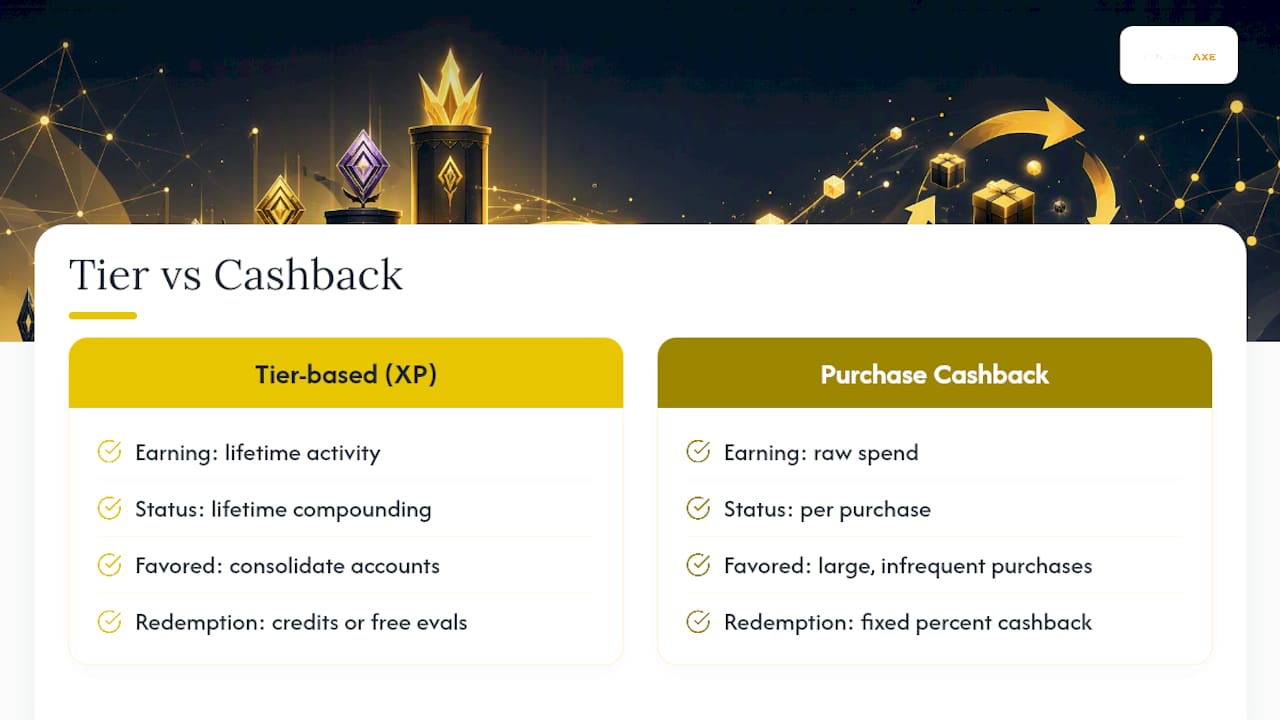
The practical difference shows up in redemption catalogs. A program built around discount codes gives you a fixed, easy-to-calculate return, but that return caps out fast. A program built around free evaluations or scaling credits can be worth more in absolute dollars, but only if you’re buying enough volume to reach the threshold. Traders running two or three accounts a year should map their actual purchase pattern against each program’s threshold structure before assuming the advertised earning rate applies to them. A 5% cashback rate sounds identical across two firms until you notice one requires $2,000 in lifetime spend to unlock any tier perks at all, while the other starts crediting from the first purchase.
Do Loyalty Programs Change How Traders Actually Trade?
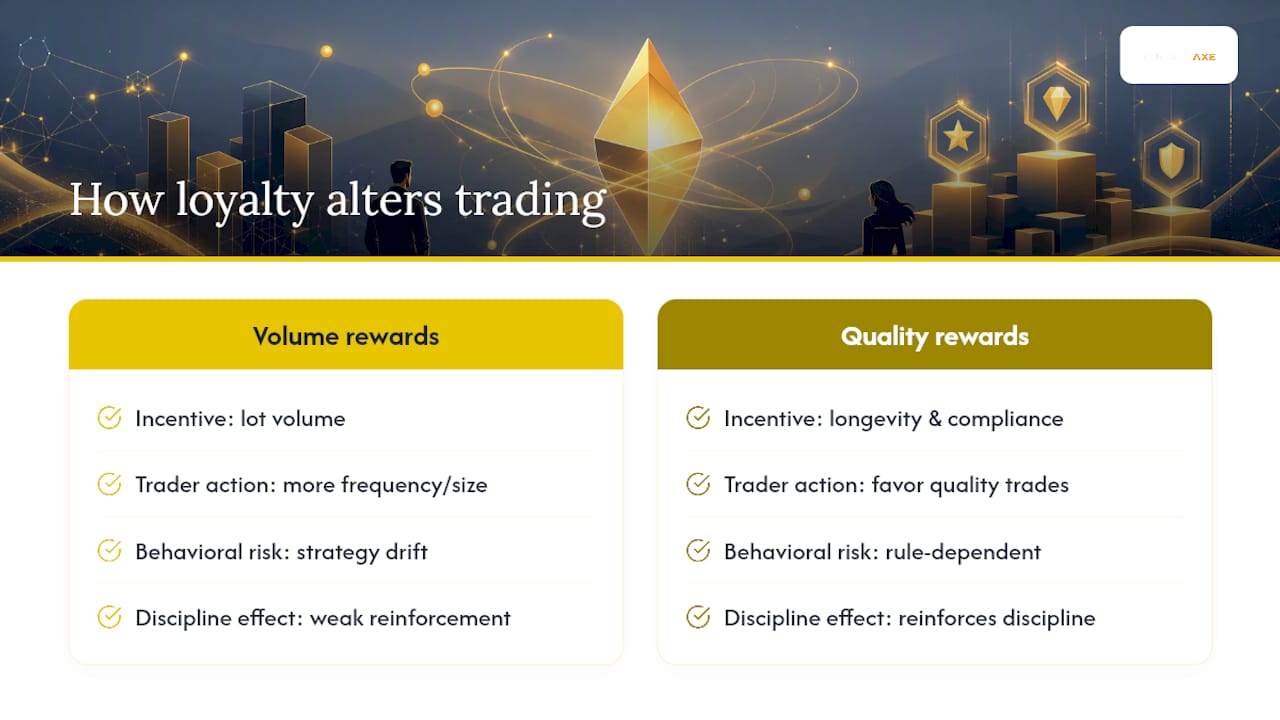
Loyalty mechanics create incentive structures that go beyond simple cost savings, and that’s worth thinking through honestly. When credits accrue per trade or per lot rather than per purchase, a trader chasing points has a subtle reason to increase trading frequency or size, independent of what their actual strategy calls for. That’s a real behavioral risk worth naming directly.
The upside runs the other direction too. Programs that reward account longevity, consistent rule compliance, or successful passes over pure volume tend to reinforce the discipline a funded account already demands. A tier system tied to passed evaluations rather than raw trade count nudges traders toward quality over churn.
Early data on engagement-linked reward systems shows measurable increases in trader participation and revenue when firms introduce these mechanics, which confirms the incentive works. Whether it improves trading outcomes for the individual trader is a separate question, and the honest answer is: it depends entirely on which behavior the specific program rewards. A points system that pays for lot volume is not neutral. Read the earning rules the same way you’d read the risk rules, because they shape behavior just as directly.
How Do Loyalty Perks Interact With Risk Management Rules?
Loyalty credits and risk parameters usually operate as separate systems, but they intersect in a few places worth checking before you rely on either. Drawdown limits, daily loss caps, and consistency rules don’t change because you’ve reached a higher loyalty tier. A Gold-tier trader still fails an evaluation the same way a first-time trader does if they breach the maximum drawdown.
Where the two systems do connect is in what a tier unlocks. Some higher tiers grant access to larger account sizes, additional reward-split add-ons, or scaling plans that wouldn’t otherwise be available at your current spend level. That’s a real perk, but it also means a trader is sometimes tempted to chase tier status by buying a bigger account than their strategy is ready for, just to unlock the next threshold.
The safer framing: treat risk rules and loyalty tiers as two separate systems that happen to share a dashboard. Qualify for tier perks through your actual trading pattern, not by purchasing account sizes you wouldn’t otherwise choose. A free reset or scaling credit is only valuable if you’d have bought that upgrade anyway.
What Are the Downsides of Prop Firm Loyalty Programs?
The biggest risk isn’t losing points, it’s letting a points balance influence a decision that should be made on trading merit alone. A trader sitting on 800 points that expire in 30 days has a real incentive to buy an evaluation they weren’t ready for, just to avoid losing accrued value.
Expiry policies are the second common trap. Programs that zero out balances after 6 to 12 months of inactivity effectively penalize traders who take breaks, which runs counter to good trading discipline that sometimes calls for stepping back from the market entirely.
Exclusions catch people off guard too. Instant funding accounts, certain add-ons, or promotional-priced challenges frequently fall outside what points can apply to, something rarely highlighted until checkout. And because loyalty programs function as a retention tool by design, they create a switching cost that can keep a trader with a firm whose account conditions no longer fit their strategy, simply because leaving means forfeiting accrued credit. None of this makes loyalty programs a bad deal. It makes them a detail-dependent one, and the details are exactly where most traders stop reading.
Why Loyalty Programs Matter More Than Discount Codes Now
The shift from one-off sign-up discounts to structured retention mechanics is the real story here, and it’s happening faster than most traders have noticed. Firms increasingly compete on lifetime value rather than headline pricing, which gives frequent evaluators real negotiating leverage they didn’t have two years ago. The catch is that loyalty can quietly become a switching cost disguised as a benefit. Before you let accrued points influence which firm you trade with next, verify the redemption math actually holds up, because the credit only matters if you can spend it.
— Jean
Try Pay After Pass and Start Earning Rune Points Today
Most loyalty programs ask you to spend first and hope the rewards catch up later. FundedAxe flips that with Pay After Pass: you start an evaluation for just $9.99 upfront and only pay the remaining $515.01 base fee once you’ve actually passed, so your loyalty spend builds from a position of proven results instead of upfront risk.

If you want to test account conditions before committing any money at all, the free $1,000 simulated trial requires no card and no deposit. From there, compare account sizes and evaluation types on the package comparison page to see where your first purchase fits, and let Rune Points start converting that spend into future discounts and free accounts. Start with the free trial, move into Pay After Pass, and build your loyalty balance from day one.
FAQ
What Are the Best Prop Firm Loyalty Programs?
The strongest programs combine automatic point tracking, permanent tier upgrades, and a clear redemption catalog rather than a single flashy discount. FundedAxe’s Rune Points program converts challenge spend directly into free accounts and discounts, and pairs with Pay After Pass to reduce upfront risk before loyalty credit even starts accruing.
Is There a Free Way to Start Earning Trading Rewards?
Yes. FundedAxe offers a free $1,000 simulated trial account with no card and no deposit required, letting you test account conditions before spending anything toward a loyalty balance.
What Are the Best Prop Firm Accounts for Frequent Evaluators?
Frequent evaluators benefit most from accounts with no time limits, static drawdown rules, and loyalty mechanics that reward repeated purchases rather than a single transaction. FundedAxe’s evaluations run 1-step, 2-step, or 3-step formats with $100,000 simulated accounts, with reward splits starting at 90% and reaching 100% with an add-on, viewable on the package comparison page.
Which Prop Firm Has the Best Loyalty Program?
There’s no single universal answer, since the best program depends on whether you value trade-activity credits, tiered permanent upgrades, or purchase-based cashback. Compare redemption catalogs, expiry rules, and whether tier status is permanent before deciding, since terms and expiry windows affect real value more than the advertised rate.
Do Loyalty Points Expire?
Most programs set an expiry window, commonly 6 to 12 months of account inactivity, after which unredeemed points are forfeited. Always confirm this rule directly on the firm’s terms page rather than assuming points last indefinitely.
Recommended
Educational content only, not financial advice. All FundedAxe accounts use simulated funds. No strategy guarantees a return.