
What a Prop Firm Trader Agreement Actually Locks You Into

A prop firm trader agreement is the binding contract that governs your relationship with a funded account: it sets your profit split, payout terms, and the firm’s right to close your account. Before you sign anything or wire a challenge fee, read two clauses first: termination rights and how profit is defined. Those two sections decide more of your outcome than your trading strategy ever will.
You’ll usually see this funded trader agreement presented one of two ways: right after you pass an evaluation, or buried in a sign-up flow you clicked through in thirty seconds. Either way, clicking “I agree” is legally binding in almost every jurisdiction, the same as a handwritten signature.
Before you pay a dime, confirm:
- Where the termination clause lives and what “sole discretion” means in it
- Whether profit split applies to gross or net realized profit
- What payout cadence and minimums actually apply to your account size
Key Takeaways
The clauses that decide whether you get paid, get frozen, or get terminated are termination scope, net profit definition, and drawdown calculation method, not the headline reward split.
| Point | Details |
|---|---|
| Read termination first | Sole discretion and modification clauses give firms the broadest power in the contract. |
| Confirm net vs gross | Ask whether your reward split applies before or after fees, swaps, and commissions. |
| Know your drawdown method | Start-of-day and peak-equity calculations produce very different real risk limits. |
| Save your evidence | Screenshot rules at purchase, keep receipts and KYC confirmations, log every trade. |
| Test before you pay | FundedAxe’s free $1,000 simulated trial lets you check the rule set risk free before buying a challenge. |
Table of Contents
- Prop Firm Trader Agreement Basics: What’s Actually in the Contract
- What Contract Language Actually Causes Account Terminations?
- How Do You Review a Prop Firm Trader Agreement Before Paying?
- How FundedAxe Structures Its Trader Agreement
- What Are the Refund and Fee Conditions?
- What Confidentiality Terms Should You Expect?
- Who Owns Your Trading Strategy Under the Agreement?
- What Liability Limits and Indemnification Should You Watch For?
- What Compliance and Risk Management Duties Fall on You?
- What Happens if a Dispute Goes Beyond Arbitration?
- When Can a Firm Suspend or Freeze Your Account?
- The Contract Clause Traders Underestimate Most
- Ready to Test These Terms? Start With FundedAxe
- Frequently Asked Questions
- Sources
Prop Firm Trader Agreement Basics: What’s Actually in the Contract
Every prop trading agreement follows a similar skeleton, even when the wording differs firm to firm. Knowing the structure means you can find the clause that matters instead of reading the whole thing cover to cover every time a firm updates its terms.
-
Profit split. Most agreements state a base percentage (often 80% to 90%) and specify whether it applies to gross profit or net realized profit after commissions, swaps, and platform fees. That distinction changes your actual take-home more than the headline number does. Some contracts also list triggers that raise or lower your split, like consistency bonuses or scaling milestones.
-
Payout mechanics. Look for cadence (weekly, biweekly, on request), minimum payout thresholds, processing windows, and any caps on a single payout. A firm that promises “fast payouts” in marketing copy but buries a 30 day processing clause in the contract is telling you something.
-
Simulated capital disclosure. Because most modern retail prop firms run evaluations on simulated infrastructure, the agreement should say plainly that the capital in your account is virtual while your payouts are real money tied to performance. If that disclosure is vague or missing, treat it as a red flag.
-
Independent contractor language. Nearly every agreement classifies you as an independent contractor, not an employee. That means no labor protections, no benefits, and limited recourse if the firm terminates you.
-
Governing law and arbitration. The contract names a jurisdiction and often requires arbitration instead of court. This affects how, where, and whether you can dispute a decision.
What Contract Language Actually Causes Account Terminations?
Most account terminations don’t happen because a trader broke an obvious rule. They happen because a trader misread how a rule is calculated or didn’t realize a “sole discretion” clause gave the firm room to act on a judgment call.
Drawdown math is the most common trap. A daily loss limit measured from start-of-day balance behaves very differently from one measured against peak intraday equity. Say your daily limit is 5% and your account starts the day at $50,000. A start-of-day calculation gives you a hard floor of $47,500 no matter how high your equity climbs during the session. A peak-equity calculation resets that floor upward every time your equity makes a new high, which can quietly shrink your remaining margin for error mid-session. Overall drawdown limits typically run 6% to 12% on top of the daily cap, and the two interact in ways that aren’t always intuitive until you’ve traded through a losing streak.

Prohibited activity lists get overlooked until it’s too late. Watch for explicit bans on copy trading across multiple accounts, latency arbitrage, and certain high-impact news strategies. Some firms allow a strategy during the evaluation phase and then flag the identical strategy as prohibited once you’re funded, which is exactly the kind of retroactive enforcement that catches traders off guard.
“Sole discretion” clauses are the broadest power a firm reserves. These allow a firm to freeze, close, or withhold payout on an account without a detailed public standard for what triggered the action. In practice, this language has been used to freeze accounts during high-volatility news events, even when no explicit rule was technically broken.
- Daily loss limits calculated differently can change your real risk tolerance by a wide margin
- Strategies allowed in evaluation aren’t automatically safe once funded
- “Sole discretion” termination rarely requires the firm to prove intent
Pro Tip: Screenshot the specific rules page and drawdown method at the moment you purchase a challenge. If a firm updates its rules later, that screenshot is your evidence of what you actually agreed to.
How Do You Review a Prop Firm Trader Agreement Before Paying?
Reading a 15-page contract under time pressure, right after you’ve decided you want to trade, is how people miss the clauses that matter. Slow down and work through this sequence instead.
- Search the document for these exact phrases: “termination,” “modify” or “modification,” “sole discretion,” “arbitration,” “net realized profit,” “refund,” and “payout” or “withdrawal.” These seven search terms surface the sections that decide most disputes.
- Confirm how drawdown is calculated. Ask support directly: is it start-of-day balance or peak equity? Get the answer in writing, not just a verbal assurance.
- Ask about refund conditions in plain terms. If a fee is advertised as refundable, ask exactly what triggers that refund. Evaluation fees are commonly non-refundable outright, and even advertised refunds are usually conditional on hitting a funded payout and staying compliant.
- Ask whether the funded account is simulated. A straight answer here tells you a lot about how transparent the firm is generally.
- Save your paper trail. Keep purchase receipts, KYC confirmation emails, and screenshots of the rules page as it existed the day you paid. If a dispute ever comes up, this is what you’ll need.
- Trade a demo under the identical rule set before risking a fee. If a firm offers a free trial account with the same drawdown and rule structure as its paid challenges, run it first. It’s the cheapest way to find out whether the rules match how you actually trade.
Roughly 4% to 5% daily loss limits are standard across the industry, which means a trader risking more than 1% per trade is often one or two bad trades away from breaching a rule they didn’t fully understand going in.
How FundedAxe Structures Its Trader Agreement
FundedAxe builds its funded account structure to match the checklist above, point for point, rather than burying trader rights in fine print.
- Account sizes and product options. FundedAxe offers simulated funded accounts up to $400,000 on MetaTrader 5, with 1-step, 2-step, and 3-step evaluations. Pay After Pass lets you start an evaluation for $9.99 and only pay the remaining fee once you’ve actually passed, instead of risking the full amount upfront.
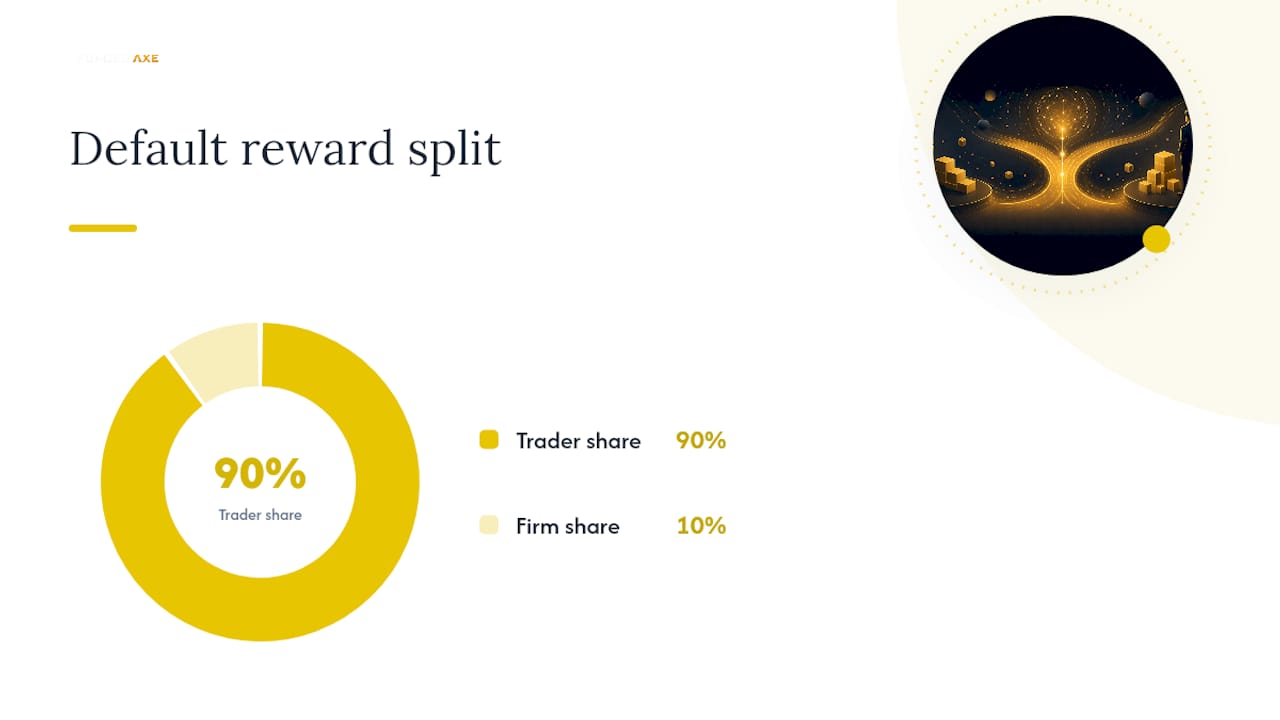
- Reward split. Traders keep a 90% reward split by default, with an add-on available to raise that to 100%.
- No phase time limits. None of FundedAxe’s evaluation phases carry a time limit, which removes the pressure to force trades just to beat a clock.
- Trading freedom. News trading, weekend holding, and EAs or algorithmic trading are all allowed, with leverage up to 1:100.
- Free trial before you pay. A free simulated $1,000 trial account requires no card and no deposit, so you can test the rule set risk free before committing to a paid challenge.
- Loyalty structure. The Rune Points program converts challenge spend into discounts and free accounts over time.
Every one of these terms is stated in the FundedAxe trader agreement itself, not just in marketing copy. Rewards can be requested starting on day 10 and every 14 days after, or every 7 days with the optional 7-Day Rewards add-on.
| Feature | FundedAxe Terms |
|---|---|
| Reward split | 90% base, up to 100% with add-on |
| Phase time limit | None |
| Leverage | Up to 1:100 |
| Payout cadence | Day 10, then every 14 days (7 days with add-on) |
| Trial account | Free $1,000 simulated trial, no card required |
All evaluations and funded accounts at FundedAxe are simulated. Traders never trade real client capital, but rewards earned on that simulated performance are paid in real money, exactly as spelled out in the agreement.
What Are the Refund and Fee Conditions?
Most challenge fees in this industry are treated as non-refundable once you’ve started an evaluation, and that’s the assumption you should plan around financially. Even when a firm advertises a “refundable” fee, that promise is almost always conditional. It typically triggers only after you pass the evaluation, receive your first or second funded payout, and stay compliant with the rules the entire time.
Treat any evaluation fee as capital you could lose entirely, unless the agreement states an unconditional refund with no performance condition attached. That framing isn’t pessimistic. It’s just how the contracts are actually written.
Fee structures vary by product type. An upfront challenge fee is paid in full before you start. A Pay After Pass model, by contrast, lets you begin for a small upfront cost and defers the bulk of the fee until you’ve demonstrated you can pass. Instant funding products skip the evaluation fee structure entirely but usually carry a different, often higher, cost basis in exchange for skipping the testing phase. Read the specific refund clause for whichever product type you’re buying. Don’t assume the refund terms from one challenge type apply to another, even within the same firm.
What Confidentiality Terms Should You Expect?
Prop firm agreements typically include confidentiality provisions that run in both directions, though the obligations aren’t always symmetrical. The firm usually agrees to keep your personal and financial information private, consistent with standard data protection practice. You, in turn, are usually asked to keep the firm’s internal rule mechanics, proprietary risk models, and specific enforcement thresholds confidential.
This matters more than it looks like on first read. Some firms restrict traders from publicly sharing exact rule enforcement details, like the precise algorithm behind a drawdown calculation, because that information could otherwise be reverse engineered by competitors or gamed by traders looking for edge cases. If you run a trading blog, post in trading communities, or discuss your funded account on social media, check whether the confidentiality clause restricts what you can disclose about the firm’s internal methodology versus what you can say about your own trading results.
Violating a confidentiality clause can be grounds for termination on its own, separate from any trading rule violation. It’s worth reading this section even if you don’t consider yourself a public figure in trading circles, because plenty of traders trigger these clauses unintentionally by sharing screenshots or explaining rule mechanics in a forum thread.
Who Owns Your Trading Strategy Under the Agreement?
Your trading strategy, in the sense of your personal decision-making process and methodology, generally remains yours. Prop firms aren’t in the business of claiming ownership over how you read price action or structure your entries.
Where intellectual property clauses get more specific is around anything you build using the firm’s platform, tools, or proprietary data feeds. If you develop a custom expert advisor (EA) or indicator using resources the firm provided, some agreements claim a license to that output, or at minimum restrict you from reselling it using the firm’s branding or infrastructure. This is a narrower claim than owning your strategy outright, but it’s worth checking if you build or sell trading tools as a side business.
The practical takeaway: read the IP section closely if you’re an algorithmic trader who develops proprietary EAs, since that’s where this clause actually has teeth. Discretionary traders using their own analysis rarely run into meaningful IP conflicts with a prop firm.
What Liability Limits and Indemnification Should You Watch For?
Nearly every prop firm agreement includes a liability limitation clause that caps what the firm owes you if something goes wrong on their end, like a platform outage, a pricing error, or a delayed payout. These clauses typically limit the firm’s liability to the fees you’ve paid, sometimes less, and disclaim responsibility for lost profits or consequential damages.
Indemnification clauses run the other direction: you agree to cover the firm’s costs if your trading activity, misuse of the platform, or breach of the agreement causes the firm financial harm or legal exposure. This is fairly standard across financial services contracts, similar to the governing-law and multi-entity structures used by larger institutional trading venues, but the practical effect for a retail trader is that you’re taking on more legal exposure than you might assume from a consumer contract.
Read the liability section specifically for how it treats simulated capital and technical failures. If a platform glitch causes a bad fill that blows your drawdown limit, the liability clause is what determines whether you have any recourse at all.
What Compliance and Risk Management Duties Fall on You?
The agreement typically obligates you, not just the firm, to actively manage risk within the stated rules. That includes monitoring your own drawdown in real time, understanding the specific calculation method the firm uses, and not relying solely on the platform’s dashboard to catch a violation before it happens.
Compliance obligations extend beyond drawdown. Most agreements require you to trade using your own analysis and decisions (even when EAs are permitted), avoid the prohibited strategies listed in the rules section, and report account access issues or suspected fraud promptly. Some firms require identity verification (KYC) before your first payout, and failing to complete it on time can delay or forfeit funds you’ve already earned.
Practically speaking, this means the burden of proof sits with you more often than not. If a dispute arises over whether a rule was violated, you’re the one who needs trade logs, screenshots, and a clear record of what the rules said at the time. Treat the agreement less like a formality and more like a living rulebook that can update, and check firm dashboard notifications for rule changes that might affect your funded status before they catch you by surprise.
What Happens if a Dispute Goes Beyond Arbitration?
Most prop firm agreements name arbitration as the primary, and often mandatory, path for resolving disputes, frequently paired with a class-action waiver that blocks traders from joining a group claim. But arbitration clauses aren’t always the end of the road, and it’s worth understanding what sits before and after that step.
Many agreements require an informal resolution period first, typically a written notice period where you have to raise the dispute directly with the firm’s support or legal team before either side can escalate. Some contracts add a mediation step between that notice period and formal arbitration, giving both sides a chance to settle with a neutral third party before committing to a binding process.
Court remains a possibility in narrow circumstances, usually when the arbitration clause itself is challenged as unenforceable, or when a claim falls into a carve out the agreement specifically excludes from arbitration (small claims court is a common exception in many contracts). The governing law clause determines which jurisdiction’s rules apply to that carve out, which is exactly why the governing law section matters even if you never expect to need it.
Practically, the informal resolution step is where most disputes actually get resolved, simply because arbitration is expensive and slow for both sides. Use that window seriously. Document everything and respond promptly, since some agreements set short deadlines for that initial notice period.
When Can a Firm Suspend or Freeze Your Account?
Suspension and freeze conditions are usually laid out as a list of specific triggers, but many agreements also include a broader catch all tied to the firm’s discretion. Specific triggers commonly include suspected rule violations under investigation, incomplete KYC verification, suspected fraud or account sharing, and payment disputes like a chargeback on the original challenge fee.
The broader discretionary trigger is where things get murkier. Some agreements allow a firm to freeze an account pending review of unusual trading activity, even without a specific rule violation identified yet. This is different from outright termination. A freeze is typically temporary and reversible, while termination ends the relationship and, depending on the agreement, the trader’s right to any pending payout.
During a freeze, check whether the agreement specifies a maximum review period or leaves the timeline open ended. An open-ended freeze with no stated resolution window is a meaningfully weaker position for you as a trader than one with a defined 5 or 10 business day review period. Also check whether a freeze affects your ability to close open positions, since being locked out of position management during volatile markets carries its own risk separate from the dispute itself.
The Contract Clause Traders Underestimate Most
Most guides on this topic focus heavily on drawdown percentages and profit splits, because those numbers are easy to compare across firms in a spreadsheet. That comparison misses the clause that actually determines whether you get paid: how the agreement defines “net profit,” and how broadly the termination and sole discretion language is written.
The math can land in the same place, or it can land nowhere close, and you won’t know which until you read the actual definition.
My honest read: traders spend far more time comparing account sizes and reward splits than they spend reading the termination section, and that’s backwards. The termination and modification clauses are where firms retain the most power, and they’re usually the shortest, driest part of the contract, which is exactly why they get skimmed. Read those two sections first, every time, before you even look at the pricing.
Ready to Test These Terms? Start With FundedAxe
If you want to see how these checklist items translate into an actual product, FundedAxe was built around low upfront risk and transparent rules rather than fine-print surprises. Pay After Pass lets you start an evaluation for $9.99 and only pay the remaining challenge fee once you’ve passed, so you’re not risking a large upfront sum on an unproven rule set. The free simulated $1,000 trial account, no card or deposit required, gives you a way to test the exact drawdown and trading rules before you commit any money at all.

FundedAxe traders keep a 90% reward split by default, with an add-on available to push that to 100%, and there are no time limits on any evaluation phase. If you want to compare account sizes, fees, and rule structures side by side, the package comparison page lays out every challenge option, and the payouts page breaks down cadence, minimums, and the faster 7-day payout add-on.
The sensible order of operations: run the free trial, compare packages that fit your account size goals, and read the full FundedAxe trader agreement before you pay for a challenge. Start with the free trial and challenge options and work through the rules yourself before committing a dollar.
Frequently Asked Questions
Is a prop firm trader agreement legally binding once I click “I agree”? Yes, in virtually every jurisdiction electronic acceptance of a trading contract terms is treated the same as a signature. Read the agreement before you click, not after.
What’s the difference between an evaluation account and a funded account in the agreement? The evaluation account tests whether you can meet the firm’s rules, while the funded account is where reward-eligible trading happens. Both typically run on simulated capital, but the rules, and sometimes prohibited strategies, can differ between phases.
Can a prop firm change the rules after I’ve already paid for a challenge? Most agreements include a modification-of-terms clause that allows rule changes, often taking effect once you continue using the account after the change is posted. Check your firm’s dashboard or email notifications regularly for updates.
Are prop firm evaluation fees usually refundable? Generally no. Evaluation fees are commonly non-refundable, and even advertised refund offers are usually conditional on reaching a funded payout and staying compliant with every trader agreement rule.
Does an independent contractor clause affect my rights as a trader? Yes. Being classified as an independent contractor typically means you don’t have employee protections, and your recourse if terminated is limited to whatever the agreement’s dispute resolution and arbitration terms allow.
What should I do if my account gets frozen without a clear explanation? Check the agreement for a stated review period, request written clarification from support, and preserve your trade logs and screenshots immediately in case you need to dispute the decision through the firm’s stated process.
Sources
- What Is a Funded Trader Agreement? Key Clauses Explained (2026)
- What Is Prop Firm Trading? A Beginner’s Guide to Funded Accounts 2026 - SyncFutures Blog
- The Complete Beginner’s Guide to Joining a Prop Firm
- How to Become a Proprietary Trader: Path, Requirements, and Reality | Monkeytrade