
Second Payout Refund Prop Firms: What Really Happens

Most “refundable fees” in the prop trading industry get returned only after you receive a funded payout, not the instant you pass an evaluation. A “second payout refund” is not the standard trigger; the overwhelming majority of refund policies key off the first qualifying payout, sometimes spreading the refund across the first two or three withdrawals instead.
That distinction changes how you should budget for a second attempt. If a firm’s marketing says “refundable fee” without specifying when, assume it means refund-at-first-payout until the FAQ tells you otherwise.
- Refundable usually means “refunded once you get paid,” not “refunded once you pass.”
- Second-payout refund triggers exist, but they’re the exception, built into a handful of specific products rather than the industry default.
- Never assume a second-payout promise unless a firm’s own terms state it in writing.
Key Takeaways
A refundable fee is a deferred performance rebate tied to reaching a payout, not a cash-back guarantee, and second-payout refund triggers remain a product-specific exception rather than an industry standard.
| Point | Details |
|---|---|
| Refunds trigger at payout, not passing | Most firms return the fee only after your first qualifying payout, not the moment you pass. |
| Cash versus credit changes value | Confirm whether your refund arrives as real cash or restricted internal credit before you buy. |
| Audits can void everything | Incomplete KYC, prohibited strategies, or suspicious patterns can cancel both the payout and the refund. |
| Run the expected-cost math | Divide the fee by your realistic pass rate, then subtract the refund value, before choosing a product. |
| Fundedaxe offers a lower-risk path | Pay After Pass charges $9.99 upfront with the remaining fee due only after you pass, cutting sunk cost on a second attempt. |
Table of Contents
- How Refundable Fees Usually Work Across Prop Firms
- What Can Void a Payout or Refund
- When a Refundable Fee or Second Attempt Actually Pays Off
- Checklist Before Paying for a Second Evaluation
- How Fundedaxe Handles Refunds and Affordable Second Attempts
- How Likely Is a Second Payout Refund, Really?
- Comparing Refund Policies Across the Industry
- Best Practices for Maximizing Your Refund Chances
- Does Chasing a Second Payout Refund Hurt Your Standing?
- Common Misconceptions About Second Payout Refunds
- What the Refund Conversation Usually Gets Wrong
- Try Fundedaxe Before You Risk a Full Fee on a Second Attempt
- Sources
How Refundable Fees Usually Work Across Prop Firms
The dominant refund model pays back 100% of your entry fee the moment you clear your first payout. A smaller group of firms spreads the refund across your first two or three payouts instead, and a few require you to hold a funded account for a minimum period before releasing anything at all, according to a prop firm refund tracker that catalogs these variants across the industry.
The mechanics matter more than the marketing copy. Consider three things before you count on a refund:
- Cash versus credit. Some firms wire the refund as cash; others drop it into your account as internal credit you can only spend on more challenges. A breakdown of how the money actually flows through these programs shows refund timing is tied to the first payout far more often than to when you passed the evaluation.
- Evaluation structure changes the math. A 1-step challenge pays out faster than a 3-step, which means the refund clock starts sooner, even when the refund percentage is identical.
- Terms can shift after you buy. Firms sometimes adjust refund timing retroactively for existing customers, which is why the purchase date on your receipt can matter as much as the FAQ page you read that day.
None of this is unusual for the industry. It’s simply not always disclosed clearly at checkout.
What Can Void a Payout or Refund
A payout request rarely gets approved without an audit first, and that audit is where refunds quietly disappear. Firms retroactively check your trading history against their rulebook, and if anything trips a flag, both the payout and the refund tied to it can get denied. A payout guide documenting common denial reasons found that incomplete KYC, prohibited strategies, and suspicious trade patterns show up again and again as the culprits.
The behaviors most likely to void your refund eligibility:
- Running the same strategy across multiple accounts under different names or emails.
- Using prohibited tactics like copy trading between accounts, latency arbitrage, or tick-scalping bots the firm explicitly bans.
- Leaving KYC verification unfinished until payout time instead of completing it during the evaluation.
- Trading patterns that look automated or synchronized with other accounts, even if unintentional.
- Missing or inconsistent trade documentation when the firm requests it during review.
Pro Tip: Complete your KYC verification the day you start your evaluation, not the day you request a payout. A stalled KYC review is one of the most common reasons payouts get delayed past the point where traders start panicking.
Keep screenshots of the product terms you agreed to at purchase. If a firm changes its refund policy later, that dated screenshot is your only real leverage in a dispute.
When a Refundable Fee or Second Attempt Actually Pays Off
Refundable-fee products almost always cost more upfront than their non-refundable equivalents. Whether that premium is worth paying comes down to a straightforward calculation, one that a glossary breakdown of refundable-fee economics recommends running before every purchase:
Expected cost = (entry fee ÷ your pass rate) − expected refund value
Adjust the refund value down if it’s paid as credit instead of cash, and down again if it arrives after your third payout instead of your first.
Here’s how that plays out for two different traders buying the same $300 refundable challenge:
- A trader with a 15% pass rate. Expected cost before refund: $300 ÷ 0.15 = $2,000. Even a full refund barely dents that number, since most attempts never reach a payout in the first place.
- A trader with a 50% pass rate. Expected cost before refund: $300 ÷ 0.50 = $600. Subtract a $300 cash refund at first payout, and the real expected cost drops to roughly $300, close to what a non-refundable challenge might cost outright.
Reset fees, add-on purchases, and the weeks you’ll wait for that first payout all belong in this math too. Run the numbers with your own historical pass rate, not an optimistic guess.
Checklist Before Paying for a Second Evaluation
Before you hand over another fee, confirm five things directly on the firm’s own FAQ page rather than trusting a forum post or a reseller’s marketing:
- The exact refund trigger: first payout, a later payout, or a minimum holding period.
- Whether the refund arrives as cash or as internal credit, and whether that credit has an expiration date or spending restriction.
- The reset price and how many resets you’re allowed on that specific account tier.
- The minimum waiting period before your first payout request, along with the minimum payout threshold.
- Whether your KYC documents and trade logs are complete enough to survive an audit without delay.
Firms that clearly answer all five of these upfront in a public payout timing guide tend to be the ones worth trusting with a second attempt. Vague answers, or answers buried three support tickets deep, are a signal to look elsewhere.
How Fundedaxe Handles Refunds and Affordable Second Attempts
Fundedaxe built its flagship product, Pay After Pass, specifically around the problem this article covers: traders getting burned by upfront fees before they’ve proven anything. Here’s what’s actually on offer:
- Pay After Pass: start an evaluation for $9.99, then pay the remaining challenge fee only once you actually pass, funded accounts up to $400,000 on MetaTrader 5.
- FundedAxe Pro: an upfront challenge where the fee is refunded on your second reward, a variant of the progressive refund model described earlier.
- Instant Funding: skip the evaluation entirely if you’d rather not risk a fee on a challenge at all.
- Reward split: 90% by default, up to 100% with the reward-split add-on, plus a free simulated $1,000 trial account with no card required.
For a second attempt, the practical order of operations is: try the free trial first to test a strategy at zero cost, use Rune Points from a prior purchase for a discount, then choose Pay After Pass so the bulk of your fee is only due once you’ve cleared the evaluation. Full terms live on the fee refund and reset breakdown.
| Product | Refund/Cost Structure |
|---|---|
| Pay After Pass | $9.99 upfront, remainder due only after passing |
| FundedAxe Pro | Upfront fee, refunded on second reward |
| Instant Funding | No evaluation fee, no refund mechanic needed |
| Free trial | $1,000 simulated account, no cost |
How Likely Is a Second Payout Refund, Really?
The honest answer is that most traders never get far enough to test it. Passing an evaluation is the first filter; surviving a funded account long enough to reach a second payout, on a product that even offers a second-payout trigger, is a much smaller subset of an already small group.
The math from the expected-cost section applies doubly here. If your realistic pass rate sits below 20%, the odds of reaching a first payout, let alone a second one tied to a refund, are thin enough that no refund structure meaningfully changes your expected outcome. Refund eligibility is a reward for consistency, not a consolation prize for buying the right product.
Where second-payout refund products genuinely help is with traders who already have a demonstrated edge, a consistent win rate across several funded accounts elsewhere, and are simply choosing between two similarly priced products. In that scenario, a refund tied to the second reward instead of the first can actually work in your favor: it gives the firm more evidence you’re a durable, profitable trader before it lets go of the fee, and it usually corresponds with a slightly cheaper entry price than instant-refund products charge.
Treat any second-payout refund as a bonus on top of solid trading, not a strategy in itself.
Comparing Refund Policies Across the Industry
Refund policy is one of the least standardized parts of the prop trading industry, and the differences show up in three places: timing, delivery, and eligibility window.
Some firms refund 100% of the challenge fee the moment you clear your first payout, full stop. Others split that same refund across your first two or three payouts, so you get a third back now and the rest later, a structure the refund tracker flags as increasingly common among mid-tier firms trying to reduce their own cash-flow risk. A smaller group requires a minimum funded-account holding period, commonly 30 to 60 days, before any refund becomes payable regardless of how many payouts you’ve already collected.
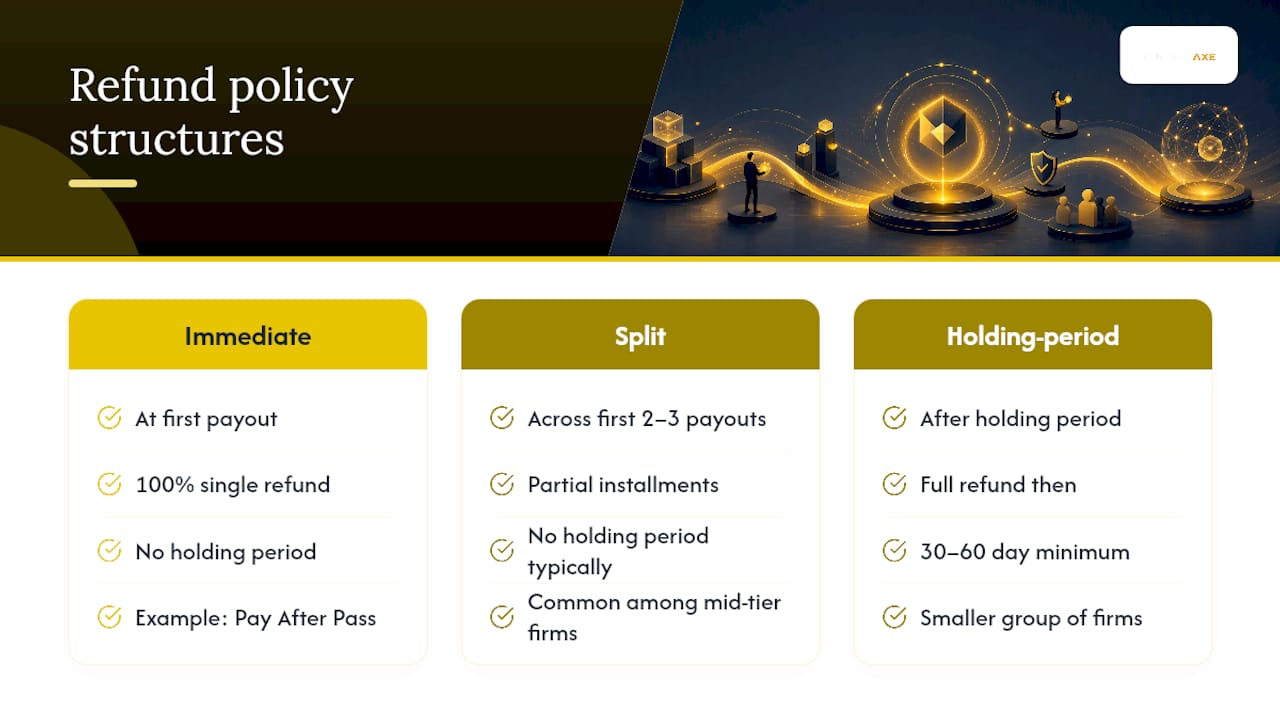
Fundedaxe’s own products illustrate two ends of that spectrum deliberately. Pay After Pass sidesteps the refund question entirely by only charging the bulk of the fee after you’ve already passed, so there’s nothing to wait on. FundedAxe Pro takes the more traditional route, refunding on the second reward, which rewards traders who’ve proven they can sustain profitability rather than just clear one evaluation.
The practical lesson: read the refund section of a firm’s FAQ as carefully as you read the drawdown rules. A firm advertising “refundable fees” in its marketing headline can still bury a 60-day holding requirement three paragraphs down.
Best Practices for Maximizing Your Refund Chances
Getting a refund or reaching a second payout isn’t about finding a loophole. It’s about eliminating the administrative reasons firms deny otherwise-legitimate requests.
Start with documentation. Keep a running log of your trades, especially around news events or high-volatility sessions, since these are exactly the periods audit teams scrutinize most closely. Complete KYC verification in week one of your evaluation, not the week you request your first payout; a stalled identity check is one of the most common, and most avoidable, reasons payouts stall past their expected window.

Read the rulebook for prohibited strategies before you deploy an EA or algorithmic system, since firms differ meaningfully on what counts as latency arbitrage versus legitimate automated trading. If you’re running the same strategy across multiple funded accounts, whether with the same firm or different ones, keep them clearly separated under your own verified identity rather than through shared logins or proxy accounts, a pattern that audit systems are specifically built to catch.
Finally, screenshot the refund terms at the moment you purchase. If a firm updates its policy later, that screenshot is the only proof of what you actually agreed to, and it’s the difference between a resolved dispute and an unanswered support ticket.
Does Chasing a Second Payout Refund Hurt Your Standing?
Requesting a legitimate payout you’ve earned doesn’t damage your standing with a firm, full stop. Firms want traders who reach payouts; that’s the entire business model working as intended. What does raise flags is the pattern around the request, not the request itself.
Repeatedly opening new evaluations right after a funded account gets flagged for a rule violation can trigger closer scrutiny on subsequent accounts, since some firms track applicant history across their own KYC systems. Requesting payouts far below a firm’s stated minimum threshold, or immediately withdrawing the smallest possible amount right at the edge of the waiting period, can also draw manual review, not because it’s against the rules, but because it looks like someone testing the system’s limits rather than trading normally.
None of this means you should avoid a second payout or a legitimate refund out of caution. It means your account history is visible to the firm in ways it isn’t to you, and a clean pattern, consistent risk sizing, complete documentation, no near-miss rule violations, is what keeps a second or third funded account moving through review without extra friction.
Common Misconceptions About Second Payout Refunds
The biggest misconception is treating “refundable” as a synonym for “risk-free.” A refundable fee is a deferred rebate contingent on performance, not money sitting in escrow waiting for you to ask for it back. If you never reach the qualifying payout, the fee is simply gone, the same as it would be with a non-refundable product.
A second misconception is assuming refund equals cash. Plenty of firms issue the refund as internal account credit rather than a bank transfer, which is fine if you plan to buy another evaluation but a poor substitute for cash if you were counting on recovering real money.
A third mistake is assuming the refund terms you read at signup are permanent. Firms can and do adjust refund timing for existing customers, which is exactly why saving a dated screenshot of the terms matters more than most traders realize until they need it.
Last, traders sometimes assume a second-payout refund trigger is standard industry practice, when it’s really a product-specific feature offered by a minority of firms. Check the specific product’s FAQ every time. Never carry over an assumption from one firm’s policy to another’s.
What the Refund Conversation Usually Gets Wrong
Most advice on this topic treats the refund as the headline decision, when the pass rate is the number that actually determines whether any refund matters. A trader with a realistic 15% pass rate gains almost nothing from a generous refund structure, because the math never gets there. A trader with a 50% pass rate barely needs the refund to make a challenge worth buying in the first place.
The conventional wisdom also underplays how much refund delivery, cash versus credit, first payout versus third, changes the real value of a “refundable” label.
What readers should prioritize first isn’t finding the firm with the most generous-sounding refund policy. It’s running their own numbers, honestly, against their own trading history, and then choosing the fee structure that minimizes what’s actually at risk while they prove themselves. That’s the entire logic behind Pay After Pass: it removes the guessing game around refund timing by simply not charging the bulk of the fee until you’ve already passed.
Try Fundedaxe Before You Risk a Full Fee on a Second Attempt
Pay After Pass exists for exactly the situation this article covers: you want a second shot at an evaluation without committing a full fee before you’ve proven anything.

Instead of paying $150 or $300 upfront and hoping a refund policy eventually pays you back, Pay After Pass starts at $9.99 and only charges the remaining fee once you’ve actually passed. If you want to test a strategy first with zero cost at all, the free simulated $1,000 trial account requires no card and no deposit. Traders who’ve bought a previous challenge can also apply Rune Points toward a discount on their next attempt, and add-ons like the reward-split upgrade or faster 7-day rewards let you tune the account to how you actually trade, whether that’s news events, weekend holding, or algorithmic systems.
Review the full payout and reward structure for account sizes up to $400,000, then start a Pay After Pass evaluation when you’re ready to make your second attempt count.
Sources
- Prop Firm Account Resets and Fee Refunds: How the Money Really Flows (2026) | PROP NAVI
- Prop Firm Refund Tracker — Which Firms Refund 100% on First Payout · TradingEdge
- How Prop Firm Payouts Work (And How to Actually Get Paid) — FundedWiki
- Refundable fee glossary — PropFirmScan