

Static Drawdown Prop Firms: Rules, Math, and How to Choose

Static drawdown is the most trader-friendly drawdown structure in prop trading, and if you hold trades overnight, run an EA, or trade news events, it’s almost certainly the rule type you want. A static drawdown prop firm sets a fixed loss floor anchored to your starting account balance, and that floor never moves. Start an account with a static drawdown limit calculated as a percentage of the starting balance, and your floor is fixed for the life of the account, no matter how much profit you accumulate above it.
That single mechanical difference changes everything about how you size positions and manage risk.
Key Takeaways
Static drawdown is the most predictable prop-firm rule structure available, and balance-based implementation is what makes it genuinely trader-friendly for swing traders, EA users, and news traders.
| Point | Details |
|---|---|
| Floor is fixed at the start | The static floor is set once from your starting balance and never rises, even as profits grow. |
| Balance-based beats equity-based | Balance-based checks ignore open floating losses, giving intraday traders more room to manage positions. |
| Growing cushion is real optionality | Profits above the fixed floor expand your working room, unlike trailing drawdown where every new high tightens the floor. |
| Verify terms before paying | Confirm “static” and “balance-based” in the binding terms page, not just marketing copy, and test support with specific questions. |
| Fundedaxe uses balance-based static drawdown | Fundedaxe applies a fixed, balance-based floor across all account sizes, with EAs, news trading, and a free trial account included. |
Table of Contents
- How is static drawdown calculated in real trading?
- How does static drawdown differ from trailing and daily drawdown?
- Who benefits from static drawdown, and who should be cautious?
- What rules come with a static drawdown prop firm account?
- How do you evaluate a static drawdown prop firm before paying?
- How does Fundedaxe implement static drawdown?
- The part of static drawdown most traders get wrong
- Fundedaxe: a static drawdown account built for how traders actually trade
- Sources
How is static drawdown calculated in real trading?
The math is straightforward. Your floor equals your starting balance minus the allowed drawdown percentage.
Floor = Starting Balance × (1 − Drawdown %)
Here’s how that plays out across common account sizes:
Typical examples show how static drawdown limits translate to fixed loss floors calculated as the starting balance minus the drawdown percentage, illustrating how the floor is derived for different account sizes.
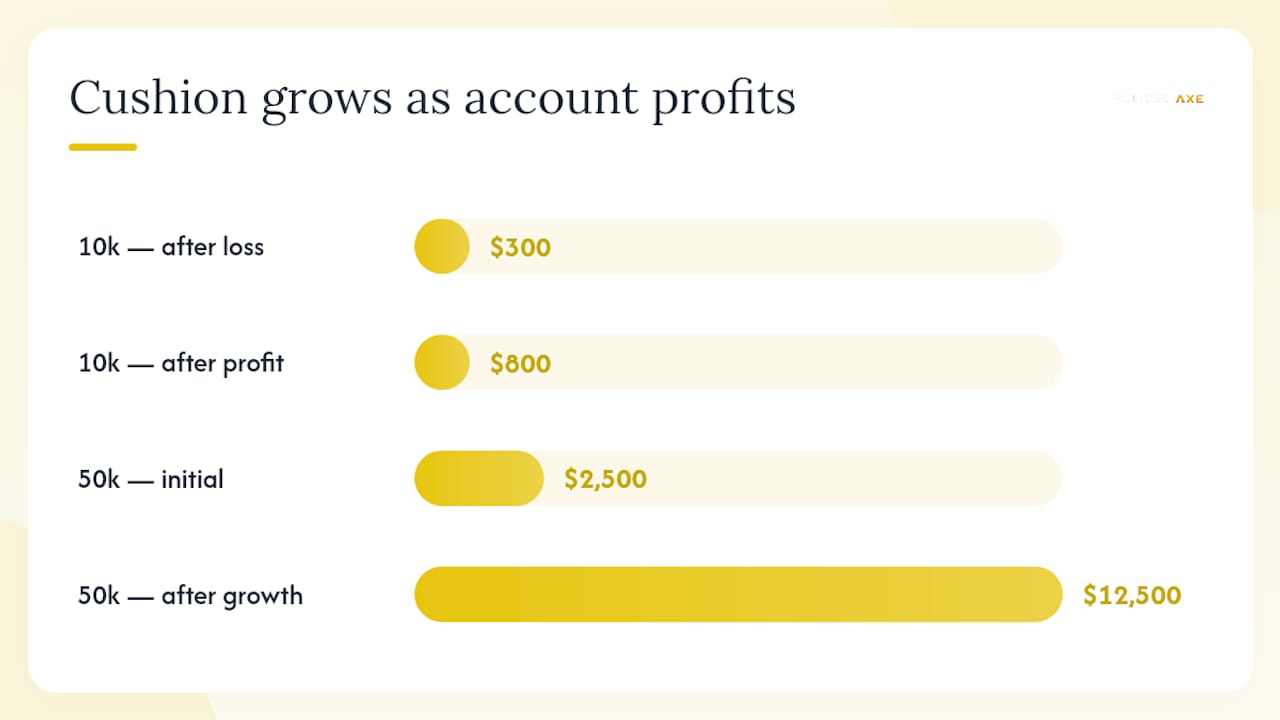
The floor is calculated once and locked. If your $50,000 account grows to $60,000, your floor stays at $47,500 (under a 5% rule). You now have $12,500 of cushion instead of $2,500, which is a meaningful shift in how aggressively you can size positions.
Balance-based vs. equity-based is the critical sub-distinction most traders miss. A balance-based check uses your cleared balance, meaning open floating losses don’t count against the floor until a trade closes. An equity-based check uses your real-time account value, so an open drawdown of $3,000 on a live trade counts immediately. Balance-based drawdown mechanics typically favor traders because intraday price swings don’t trigger a breach as long as you close profitable. Most firms advertising static drawdown use balance-based checks, but verify the exact wording before you pay.
Step-by-step worked example for a $10,000 account with a 5% static rule:
- Starting balance: $10,000. Floor: $9,500.
- You open a trade. Floating loss hits $600. Equity = $9,400. Under a balance-based rule, no breach yet.
- Trade closes at a $200 loss. Balance = $9,800. Floor still $9,500. Cushion remaining: $300.
- Next trade closes at +$500. Balance = $10,300. Floor still $9,500. Cushion now $800.
- You can now lose up to $800 before a breach, not just $300.
Pro Tip: Size each position so your maximum expected loss on that trade is no more than 25–30% of your remaining cushion. That habit alone prevents the single-trade blowout that ends most funded accounts.
According to PropFirmMap’s drawdown guide, the static floor’s fixed nature means profits genuinely expand your working room, which is the structural advantage trailing drawdown cannot offer.
How does static drawdown differ from trailing and daily drawdown?
Understanding the differences isn’t just academic. It directly changes which trades you can take and when.
Static drawdown: Floor is fixed at the starting balance minus the allowed percentage. Profits grow your cushion. The floor never rises.
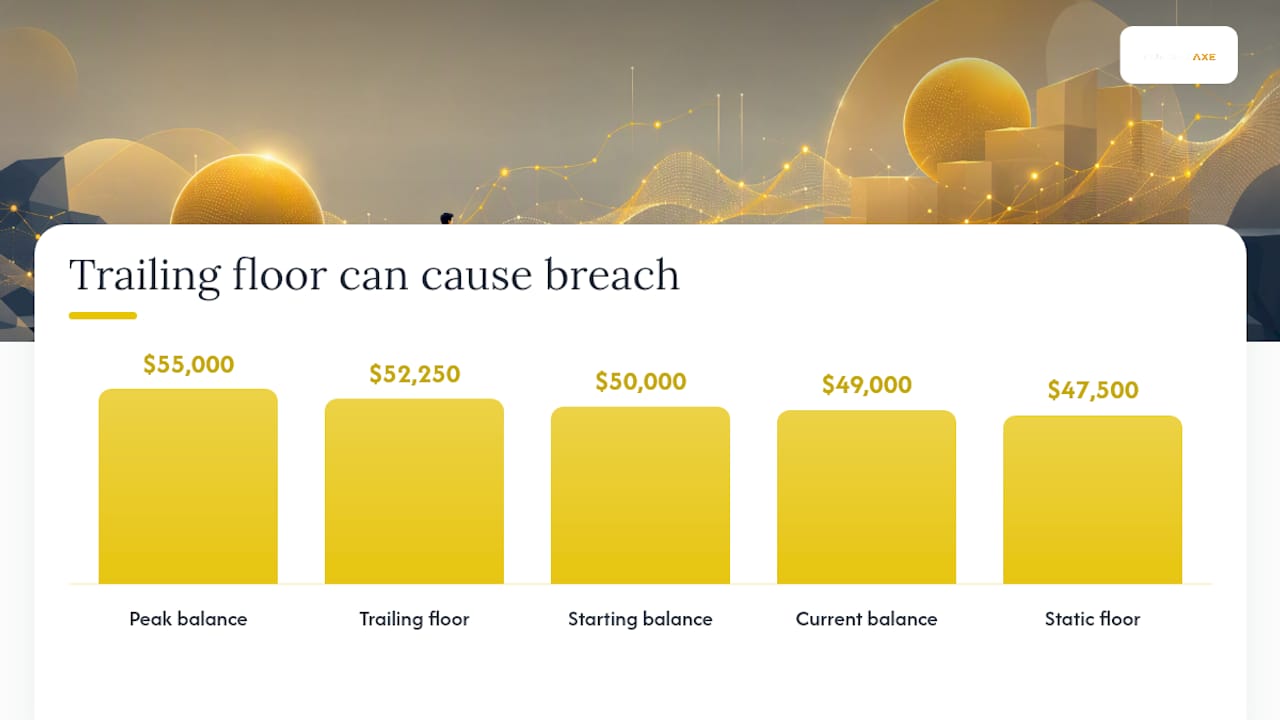
Trailing drawdown: The floor follows your highest balance (or highest equity, depending on the firm). If your $100,000 account peaks at $105,000, the floor moves up to $95,000 under a 5% trailing rule. A subsequent drawdown back to $95,000 breaches the account even though you’re still above your starting balance.
Daily loss limit: A separate rule, often layered on top of either static or trailing drawdown, that caps how much you can lose in a single calendar day. Breaching it typically locks the account for that day or terminates the challenge.
Overall max drawdown: The total loss allowed from peak or starting balance, depending on the firm’s definition. This is where static and trailing diverge most sharply.
The trailing drawdown rule punishes success. Every time you make money, the floor rises and your margin for error shrinks. With static drawdown, profits are yours to keep as cushion. That’s not a minor difference — it’s a fundamentally different risk environment.
Here’s how the same trade sequence plays out under each rule, starting from a $50,000 account with a 5% limit:
- Account grows to $55,000.
- A losing streak brings balance back to $49,000.
Under static drawdown: Floor is $47,500. You’re still $1,500 above the floor. Account lives. Under trailing drawdown: Floor has moved to $52,250 (5% below the $55,000 peak). You breached at $52,250. Account terminated.
The trade-management consequences for each rule type:
- Static drawdown: You can let winning trades run without fear that profits will tighten your floor. Swing trades, multi-day holds, and news plays are all viable.
- Trailing drawdown: You’re incentivized to lock in profits quickly and reduce position size after a run-up, because every new high raises the floor against you.
- Equity-based daily rule: Intraday spikes against open positions can trigger a breach even if the trade recovers. Scalpers and news traders face the most exposure here.
- Balance-based daily rule: Only closed losses count. Open drawdown is irrelevant until the trade closes, giving intraday traders more breathing room.
FundedAxe’s comparison of static and trailing drawdown lays out which trading styles suit each rule type with concrete examples, and it’s worth reading before you commit to any firm.
Who benefits from static drawdown, and who should be cautious?
Traders who benefit most:
- Swing traders and position traders who hold trades for days or weeks. The static floor never rises against them, so a multi-day drawdown doesn’t compound into a breach the way it can under trailing rules.
- EA and algorithmic traders running strategies with defined max drawdown parameters. A fixed floor is easier to model and backtest against.
- News traders who accept short-term volatility for larger moves. Under a balance-based static rule, the spike against an open position doesn’t count until the trade closes.
- Traders focused on profit extraction. Growing your cushion above the fixed floor creates real optionality for increasing position size over time.
Traders who should think carefully:
- High-frequency scalpers who open dozens of trades per session. Each small loss chips away at a fixed cushion, and there’s no mechanism to “reset” the floor upward as there is with some trailing structures.
- Traders who over-leverage after a winning streak. The growing cushion can create false confidence. A static floor doesn’t protect you from yourself.
Prop Firm Match consistently identifies static drawdown as the preferred structure for traders who want a predictable, fixed risk ceiling rather than a moving target.
One psychological note worth stating plainly: static drawdown tends to reduce panic-driven decision-making. When the floor is fixed and visible, traders can calculate their exact remaining cushion at any moment. That clarity, compared to the anxiety of watching a trailing floor rise with every profitable tick, changes how people behave under pressure.
What rules come with a static drawdown prop firm account?
Beyond the drawdown type itself, a prop firm’s terms page contains several other elements that interact with the static floor. Here’s what to verify:
Checklist of items to confirm on any terms page:
- Drawdown type: static or trailing (look for exact wording, not just marketing copy)
- Balance-based or equity-based calculation (ask support if the terms page is ambiguous)
- Daily loss limit: amount, reset time (midnight server time vs. midnight EST matters)
- Overall max drawdown percentage and its reference point (starting balance vs. peak balance)
- Minimum trading days required before a payout request
- Profit target percentage for each phase
- Reset conditions: can you reset after a breach, and at what cost?
- Allowed instruments: forex, indices, commodities, crypto
- EA and algorithmic trading: permitted or restricted?
- News trading and weekend holding: explicitly allowed or prohibited?
- Payout timing and minimum withdrawal amount
Typical values reported in the industry suggest drawdown, daily loss limits, and profit targets usually fall within qualitative ranges and vary by firm; always verify the specific firm’s published terms.
Watch for this clause pattern: “drawdown is calculated on account equity at any point during the trading day.” That single phrase converts a nominally static rule into an equity-based intraday check. It’s one of the most common ways a firm’s marketing and its actual terms diverge.
EliteTraderFunding’s help documentation is a useful example of how a firm can clarify whether its static plan uses balance or equity for the drawdown check, and the difference in wording is subtle enough that you need to read it carefully.
Some firms also embed automatic resets that trigger if your balance drops below a threshold, converting a static account into something closer to a trailing structure mid-challenge. That’s a red flag worth screening for.
How do you evaluate a static drawdown prop firm before paying?
Follow these steps in order. Skipping any of them is how traders end up paying for a challenge that doesn’t match what was advertised.
- Confirm the drawdown type in writing. Find the word “static” or “fixed” in the firm’s official terms page, not just the marketing homepage. If it only appears in a blog post or FAQ, ask support to point you to the binding terms.
- Verify balance-based vs. equity-based. Ask support directly: “Does your drawdown check use cleared balance or real-time equity?” An acceptable answer names one clearly. A vague answer (“it depends on the situation”) is a red flag.
- Check the daily loss limit reset time. Server midnight and New York midnight can differ by five hours. For active traders, that gap matters.
- Look for payout proof. Find independently verified payout screenshots or third-party reviews, not testimonials on the firm’s own site. Check the dates on those proofs.
- Check the terms page timestamp. Some firms update terms after traders pay. A terms page with no version date or “last updated” timestamp is a warning sign.
- Test support response quality. Ask a specific technical question about the drawdown calculation. If the answer is slow, generic, or contradicts the terms page, that’s your signal.
- Start with the smallest account size or a trial account. Verify the mechanics work as described before committing to a larger challenge fee.
Red flags to watch for:
- Marketing that says “static drawdown” but terms that say “equity-based” or “real-time equity check”
- No published payout proof from real traders
- Unusually low entry fees paired with unrealistic profit targets (e.g., 20% profit target in 10 days)
- Affiliate-heavy review ecosystems where every review links to the same signup page
- Processors or payment methods with no chargeback protection
Questions to ask support before paying:
- “Is the drawdown calculated on balance or equity?”
- “Does the daily loss limit reset at server midnight or EST midnight?”
- “Are EAs and news trading explicitly permitted in the funded phase, not just the challenge phase?”
- “What happens to my account if I hit the daily loss limit but not the overall drawdown limit?”
Pro Tip: Copy the firm’s exact terms-page wording for the drawdown rule into a document before you pay. If the terms change after your purchase, you have a timestamped record of what you agreed to.
FundedAxe’s getting-started resources walk through evaluation model mechanics (1-step through 3-step) and common rule items worth checking before committing to any challenge.
How does Fundedaxe implement static drawdown?
Fundedaxe uses balance-based static drawdown across all its evaluation and funded accounts. The floor is set at the starting balance minus the allowed drawdown percentage and does not move for the life of the account. Open floating losses don’t count against the floor until a trade closes, which is the most trader-friendly implementation of the static rule.
Fundedaxe’s static-drawdown feature set:
- Account sizes from $5,000 to $400,000 (Pay After Pass starts at $10,000)
- 1-step, 2-step, and 3-step evaluation paths
- Balance-based static drawdown on all accounts
- 90% reward split, up to 100% with the reward-split add-on
- MetaTrader 5 platform with full EA and algorithmic trading support
- News trading and weekend holding explicitly permitted
- No time limit on any evaluation phase
- No consistency rules
- Leverage up to 1:100
- Swap-free accounts available as an add-on
- Rewards requestable from day 10, then every 14 days (or every 7 days with the add-on)
- Free $1,000 simulated trial account, no card required
Mapping Fundedaxe to the evaluation checklist:
- Drawdown type confirmed static: yes, balance-based static drawdown on all accounts.
- Balance vs. equity: balance-based. Open trades don’t count until closed.
- Daily loss limit: published on the terms page; verify the reset time for your timezone.
- EA and news trading: explicitly permitted in both challenge and funded phases.
- Payout timing: day 10 minimum, then every 14 days standard.
- Trial account: free $1,000 simulated account available with no card or deposit.
Pro Tip: Use Fundedaxe’s free $1,000 trial account to verify that the balance-based drawdown behaves exactly as described before you pay for a challenge. Open a trade, let it run into floating loss, and confirm the balance figure doesn’t move until the trade closes.
For traders who genuinely prefer trailing drawdown because their strategy is built around locking in profits quickly and reducing exposure after a run-up, a trailing-drawdown firm may suit them better. Fundedaxe’s static vs. trailing drawdown comparison is the clearest resource for making that call.
The part of static drawdown most traders get wrong
The most common mistake traders make with static drawdown isn’t misunderstanding the math. It’s misusing the cushion.
When a trader grows a $50,000 account to $60,000 and realizes they now have $12,500 of cushion instead of $2,500, the temptation is to scale up aggressively. The floor isn’t moving, so the logic feels sound. But a static floor doesn’t protect you from a strategy that’s suddenly stopped working. A 15% drawdown from $60,000 puts you at $51,000, still above the $47,500 floor, but you’ve given back most of your profit and your cushion is thin again.
The traders who do well under static drawdown treat the growing cushion as a buffer, not a license. They extract profits on a schedule rather than letting the balance run indefinitely. They log their intraday equity at the end of each session, not just their closed balance, so they have a realistic picture of how close they’ve come to the floor on any given day. And they keep position sizing proportional to the original cushion, not the current one, until they’ve demonstrated consistency over multiple weeks.
There’s also a subtler point about firm selection. Several newer firms have built their entire marketing around the phrase “static drawdown” while embedding equity-based intraday checks in their terms. The marketing is accurate in a narrow sense, the overall max drawdown is static, but the daily check uses equity, which means an intraday spike against an open position can still breach the daily limit. PropXP’s review on JoinProp is one example of how firm-specific program models can differ even when the headline rule sounds identical. Read the terms, not the homepage.
Fundedaxe: a static drawdown account built for how traders actually trade
Traders who’ve read this far know exactly what to look for: a fixed, balance-based floor, no equity intraday checks, EAs and news trading permitted, and a firm that can show payout proof and answer technical questions clearly. Fundedaxe was built around that specification.

The Pay After Pass model means you start for $9.99 and only pay the remaining challenge fee when you actually pass, which removes the upfront financial risk that makes most traders hesitant to try a new firm. Accounts scale from $10,000 to $400,000, the reward split starts at 90% and reaches 100% with the add-on, and there are no time limits on any phase. If you want to verify the mechanics before committing, the free $1,000 simulated trial account requires no card and no deposit.
Compare all Fundedaxe challenges side by side, confirm the static drawdown terms for the account size you want, and start the trial to see the balance-based floor in action before you pay a cent.
Sources
- Prop Firm Drawdown Rules Explained: Balance-Based vs Equity-Based (2026 Guide) - PropFirmMap
- Prop Firms with Static Drawdown | Prop Firm Match
- PropXP - Prop Firm Review | JoinProp
Recommended
Educational content only, not financial advice. All FundedAxe accounts use simulated funds. No strategy guarantees a return.